
Ramadan – 20+ days to go

Okay, so I’m experiencing my first Ramadan. Let me first say that I mean no religious disrespect and all of my complaints are completely personal and selfish… having said that, I was surprised at how immediately I felt affected. Even on the first day I could feel a change in the city. The energy flow seems to ebb less than flow.

Here is a good description of Ramadan that I found online: “Ramadan, the ninth month in the Islamic or Hegira calendar, is when the Koran was revealed to the Prophet Mohammed and is thus considered the ‘Holy Month’. A time of spiritual reflection, Muslims fast for the entire month from daybreak to sundown, eschewing even drinking-water [ending in a three-day feast called Eid al-Fitr]. If for some reason you cannot fast for the entire month, the days are to be made up elsewhere or you must volunteer and feed someone or do other charitable deeds… It is perhaps the equivalent of the Christian Christmas since it is a time of exchanging gifts, and buying new clothes. The Islamic calendar is lunar and it moves eleven days ahead each Gregorian calendar year. So when Ramadan falls in summer, the heat and long daylight hours make fasting a not inconsiderable undertaking for a whole month. And yet most Muslims view it as a time of celebration. The meal breaking the fast, called iftar, starts [at sundown] and the last meal before the fast, called suhour, takes place anywhere from 0100 until daybreak which according to the Koran is defined, ‘until the white thread of light becomes distinguishable from the dark thread of night at dawn.’ The times change every day and obviously are different throughout the world… The last 10 days of the month are considered the holiest with the 27th Ramadan, ‘Laylat al Qadr’ or Night of Power, being the actual night the Koran was first revealed. On this night hundreds of thousands of men still go to the mosque and spend the entire night in prayer.”

So, as you can see, not drinking or eating, or even more importantly smoking (everyone here smokes, everywhere), from sunup to sundown, makes for a tired and cranky crowd. The times of sundown are printed in the newspaper, however I was told that typically people don’t start feasting at exactly 6:17pm. They start with tea, relax and then begin the meal and the festivities, which often last throughout the night (though without alcohol I’m not sure why or how they last that long).

The embassy printed some Ramadan information which stated that it was impolite to openly eat or drink in public during fasting times (i.e., daylight), so I am consciously not drinking water during my Arabic class (as my teacher is Muslim) as well as in public, despite my shopping outings and the heat. I have relied on moments of grabbing a swig in bathrooms, hallways, stairwells and dark museum exhibit rooms before resuming public interaction.

As a result of fasting, not smoking, and the heat of summer, the momentum of Cairo comes to a slow crawl around 3:00pm. Shops close, businesses halt, work in general ceases. Last week, as I was walking from the embassy to the fabric market (with plans on buying fabric for some little upholstery jobs I have in mind), I saw men lying around, in parked cars, on benches, on the ground, under bridges, in bobbing feluccas – all moreso than normal (let’s be honest here, there are a LOT of seemingly idle men in Cairo, but typically they are at least sitting up).

The only thing that increases to a frightening pace is the traffic, particularly between 4:00-6:00, when people are racing to get home for the iftar meal. We have actually been advised to stay off the roads, out of cars and taxis during this time, however last Thursday I found myself in a taxi at 4:00 careening like I’ve never careened before up the Corniche from Maadi to Zamalek. It was actually rather harrowing, and I will definitely not do that again (though I will say my Zen breathing is getting much better).

The shops closing has been a bit of a bother for me, as I’m still trying to figure out when some of them open during non-Ramadan times. But here and there I see signs posted, saying “Closed for iftar, 3:30-7:30pm, open 7:30-11:00pm.” So I just have to switch my shopping times to late evening. Blech. Restaurants are open, but typically only non-Muslims eat there before sundown, obviously, and alcohol is not served in most establishments. (Egypt is not a completely “dry” country, but alcohol is certainly not highly prevalent. We tend to purchase ours from the commissary, which carries beer, wine and spirits.) Most tourist sites have limited hours, opening up later in the morning and closing around 3:00pm.

Another result of the fasting, heat and not smoking is the fighting and arguing. In general, Egyptians may talk at each other loudly, gesticulate wildly, but honestly I’ve never seen a fight. But since the start of Ramadan, I’ve seen more angry yelling arguments than in the prior four months combined and I can only imagine it’ll get worse as the month progresses.

Another change, which doesn’t affect us, but amuses us, is that the “Fashion TV” channel displays “Removed for Ramadan” when you pass by it on the remote. I haven’t seen that on any other channels yet.

The city itself is decked out with strings of lights, banners, colorful fabric swags, and brightly colored metal lanterns. Apparently shops actually have to apply for a lighting permit and the Electricity Company of North Cairo charges 300LE (about $60) for every 50 lamps that a business displays in an attempt to thwart black-outs. We have ventured out in the evening, attempting to eat dinner at one of our favorite restaurants which we found was closed, and there was definitely a festive air about. However, I am also personally very conscious of all the live animals throughout the city and know that the last three days of feasting are precluded by massive slaughtering. One guide book mentioned the number of animals being slaughtered results in rivers of blood in the streets. I have full intention of either being out of the city/country or will remain indoors for those “festivities.” A friend said she enjoys Ramadan because it’s quieter and no one’s smoking. I disagree and will just have to wait it all out.
Choir Practice

Under the continuing life-expansion category, Ron and I decided to check out the Cairo Choral Society. We had seen advertisements for practices beginning in September, and with the potential-hindrance of location not being an issue (practices are held at the church 1 ½ blocks from our home), we grabbed another friend and walked over Tuesday night.

Both Ron and I have sung in high school productions and choirs, but neither of us has done anything (other than the odd spontaneous show at, say, one’s wedding) more formal in our adult years. We signed in, got our music, boldly claimed our singing parts (soprano and tenor) as if we knew what we were doing, and started milling about with the other choir members. It was a very internationally-eclectic group. There was a large German contingent, quite a few Brits, we met a nice Dutch man who had a great tenor voice that Ron said he relied on for note-matching, and I similarly relied on the American University student I sat next to.

The conductor was an American and I was definitely impressed with, and intimidated, by him. This adult choir stuff is the real deal! They take this very seriously. They have a strict attendance policy and practice is once a week for over two hours. My abs actually ached after singing practice – guess I was breathing correctly.

We’re practicing two pieces for possibly three concerts in early December. One is a Hayden piece, in Latin, and the other is Beethoven in German. Oh, and everyone sight-reads. So, even though we have an excellent piano accompanist, I swear Ron and I were the only ones who waited for him to play the notes we were to sing (or rely on Mr. Dutch or Ms. AUC), before issuing sound. Definitely intimidating.

But I think we’re going to continue (and get the music from iTunes so we can learn it in spite of our lack-of-sight-reading abilities). As an added bonus, when we were given a break and all raced outside to get out of the stuffy hot church, the outside of the church was rippling with little geckos here and there. So I was quite amused (I sound ADD, don’t I?).

Weekend Explorations: Orphanages & Garbage City

Two weeks ago, in the embassy’s weekly newsletter, there was an ad seeking volunteers for two local orphanages. I contacted one to see what was needed, and after a few exchanges somehow managed to convince Ron to come with me on Saturday morning. Coincidentally another couple from our building was going, and we were able to go with them and their driver (the embassy offers a nice service of being able to “rent” a car/van and a driver for weekend excursions, for a fee of course).

Truly having no idea what to expect, we piled in the car, bringing juice boxes and chocolates with us, and rode out to Maadi to the coordinator’s house. She’s the wife of a high diplomat here and lives in this amazing oasis of a house in Maadi. I’d walked by it a million times, but never knew what existed behind the walls. She’d done an amazing job of landscaping her huge yard and it was tranquility in flora. She told us she’d been working with Mother Teresa’s Orphanage here in Garbage City as well as other locations, such as India, for several years. Her background is in acupuncture and acupressure and she actually treats the sisters at the orphanage who suffer from arthritis, among other pains.

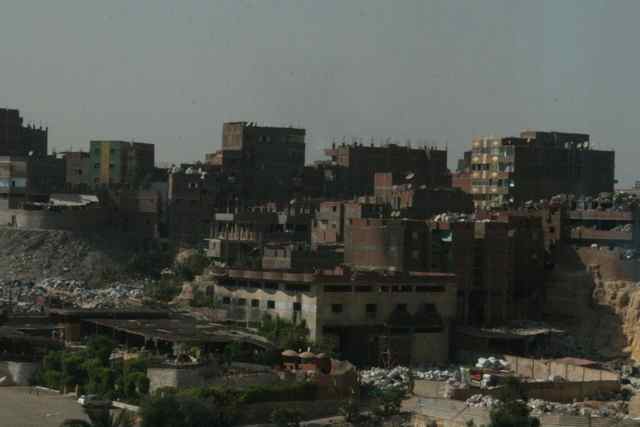
We loaded back into our embassy van and followed her car out to Garbage City. I can’t really speak in depth about Garbage City, as I haven’t fully explored it yet, but it’s truly what it sounds like. It’s essentially a dump, that a whole class of people, called Zaballeen, live in. It’s located right next to (and at times seems to merge with) the City of the Dead. The Zaballeen have established themselves as the primary garbage collectors and recyclers of Cairo. Young boys pull carts throughout the city and dig through the city dumpsters and bring back as much as they can to recycle and re-sell. It’s a very family-oriented society; the children do not attend school; the young boys are responsible for retrieving the garbage; the women and girls are tasked with separating the garbage back at home. For obvious reasons, there’s a controversy over the Zaballeen on many levels. Social agencies don’t like that the children are kept out of schools, and the government (allegedly) doesn’t like the fact that it can be a rather lucrative business. It’s alleged that many Zaballeen actually have higher salaries recycling garbage than most government employees (the local police and traffic cops apparently make pittance, which leads directly into the whole baksheesh culture where the police – allegedly – demand bribes from all manner of people they come into contact with).


(Photo looking at one area of Garbage City)

Anyway, our forays into Garbage City have primary been this one time. We’ve driven by it and around it, but going to the orphanage was the first time we have driven directly into it. And I am very grateful we didn’t attempt it on our own. I never felt threatened, but it was definitely a new experience lumbering through narrow alleys (in our large SUV), with high buildings on all sides, doorways looking into seemingly abandoned rooms stacked high with folded cardboard, piles of plastic, mounds of paper, stacks of steel and metal leaning against walls, etc. Everything was coated in a thick heavy layer of black; it was like highly determined soot. Even the people were covered in it as they walked around. The streets were by far the narrowest we’ve seen, at times physically impassable and we had to wait for either people to walk by, trucks to move, or horses to be nudged aside.

Mother Teresa’s Orphanage is located to the left, right, left, left, right (essentially in the middle). They opened the tall gates for us and our cars pulled in. The sisters were waiting for us – all dressed in the white with blue-trimmed habit and tunic. They are apparently from all over the world. They all had the best smiles and were so welcoming to us.

Ron and the other guy, followed one sister, wandering off with a toolbox (manly things to be done and pounded on, I assumed). I stayed with the other women and we were taken up an outdoor staircase to the second level, past a few empty rooms to an open room with a waist-high wall/gate separating the room into a long hallway and a large area where about eleven babies were in varies states of sitting, lying, sleeping, fussing. We removed our shoes and got through the gate. I was the last one in and stood there for a minute not really sure what to do. The area had two twin mattresses on the floor, toys strewn about, three cribs against one wall, a table with bottles stacked, high shelves with stuffed animals sitting in rows and two open windows bringing in a light but nice breeze. The other women had chosen various babies to hold and comfort. There was a young girl sitting at my feet in a pretty little dress. I leaned down and touched her hair. I looked up and saw across the room there were three boys sitting near each other but with no adult near by, so I carefully stepped over to them and sat down in the middle. One was starting to fuss a little, so I grabbed him and held him on my lap. I then reached over to the little boy who was sitting with his back to me and caressed his face. He turned his head around to see who I was and just smiled the biggest smile. I have to admit a bit of heart-melting occurred. Next I then reached out to the third boy and caressed his cheek and he leaned into my hand with great force and just smiled. It was a strangely shocking sensation – to have something as simple as a touch be so immediately and intensely appreciated.

So there I was, surrounded by my three boys, making sure everyone was getting attention and hugs and caresses – feeling a tad out of my element. I was talking to them constantly, knowing that not only was I speaking English to a bunch of Egyptian orphans, but I was also talking to them like I do Chuckles and Ricky. Okay, please remember, I am an only child. I only have a few girlfriends with children, most are still hunting down Mr. Right. So bottom-line is I have minimal experience with children and my maternal instinct has been honed for the four-footed. But I’m working on it.

We stayed there for only a few minutes (maybe 10?) before a wave of new volunteers came in. I passed off my boys to the new eager huggers and wandered off with one of the women to find where Ron and her husband had ended up. We wandered through a maze of rooms and stairways, at one point coming face to face with a very large rat who was lumbering through a doorway. He was particularly huge and appeared injured. We walked around him and went through an outdoor courtyard into the handicapped room, where the husbands were. Apparently they had been here from the beginning. This room had about ten children, older, maybe ranging from three to six, who were either physically or mentally handicapped. Ron and I helped with feeding; again, minimal experience, particularly with handicapped children, some of whom have difficulty swallowing, so we all needed a good hosing off afterwards. Ron said when he arrived, he was handed a child and a bottle. He said he sat there for a minute before summing up the courage to ask one of the young girls for help and she helped him situate the child and get them on the bottle.

After about an hour, we all gathered our people and called the driver back. We met him in the driveway, after walking through a large open room with twin cots lined up against the wall. There were only two elderly inhabitants; one was lying down on a cot in the middle of the room and the other was sitting on a cot by the door we walked through. She seemed very happy as she sat there babbling animal noises at us.

The orphanage itself, while not luxurious, was clean and well-maintained. We were told that apparently most, if not all, of the children who are here, are technically not orphans. They all have parents, some of whom visit regularly. But in the case of the babies, many of the parents are too young themselves to properly care for the children, so they remain at Mother Teresa’s for several years until their mother can take them back. For the handicapped children, the parents cannot meet their needs, so the orphanage cares for them. I don’t know how these are arranged, or how long they typically stay there.

Our way out was as adventurous as our way in. We were stuck for several minutes behind a large truck that was being loaded with boxes of kitchenware for sale. There was a steady stream of young boys carrying these boxes to the truck, sometimes stacked way over their heads. There were a few tumbles, but typically an older boy following would stop and grab the fallen boxes. Our driver told us they were manufacturing the pots and pans around the corner. I’d be really interested to explore this area more and really delve into the social matrix of it all. It’s truly fascinating.

Despite Ron and I feeling completely out of our element, and admitting our ignorance, we agreed that we’d go back again. They get a lot of volunteers on the weekends, so I also might try to go out during the week as well. I’ve also agreed to help the woman who arranged all this create some brochures and flyers for a classical concert she’s arranging for January as a fund-raiser. Good Dip-Wife doings to keep me out of trouble (or in the city dump).

**********

Zana Briski, who created the NGO “Kids with Cameras,” and won an Academy Award for her documentary, “Born into Brothels” in India, also ran a program here with the Zaballeen. (NOTE: If anyone hasn’t seen “Born into Brothels” I recommend it highly. It’s heartbreaking and spirit-lifting.) I contacted the local representative, but their program is essentially complete and they are focusing on the few children who they have gotten into school, so they didn’t require any volunteers currently (but I will keep in contact as I’m so impressed with their mission and programs).

Their website gave a nice overview of the Zaballeen issue: “The 16 million people who live in Cairo, the largest city in the Middle East and Africa, generate over 9,000 tons of garbage every day. At no cost to the government, a group of poor and displaced settlers from Egypt's rural south, the majority of who are Coptic Christians, have developed an economy and community from collecting the city's trash. Known as the Zaballeen, or "garbage collectors", they not only help to maintain the cleanliness of the city, but sort out all recyclable materials to sell back to the manufacturers. Because of their efforts, 80-90% of all the garbage they collect is recycled and re-used. This unique income-generating model is an extraordinary example of environmental sustainability that has been lauded, studied and replicated around the world.

While the estimated 65,000 Zaballeen provide a valuable service to the city and the environment, they are not formally recognized by the government and are largely rejected by Egyptian society because of the stigma associated with their work. Most are illiterate and suffer from health problems due to the piles of waste that occupy their district. In addition, the government has recently secured contracts with foreign multi-national waste disposal companies in an attempt to modernize Egypt. These contracts cost millions of dollars, demand collection fees from the citizens of Cairo, and require only 20% of the waste to be recycled. They also threaten to destroy the already meager livelihoods of the proud, spirited and hard-working Zaballeen.

In September 2006 project director Teriz Michael, a native of Cairo, began a photography workshop for a group of children in the Moqattam Hills, the largest of the five Zaballeen districts. Held at the Monastery of St. Simon the Tanner, the classes were designed to allow the children to explore the world outside their garbage community, as well as discover their inner voices and creativity.

Over the course of two months, fifteen children between ages 8-12 learned not only how to take pictures, but were encouraged to dream and recognize their own potential. Photography and the artistic process became the catalyst for building self-esteem, discipline, and respect. For many, these classes helped them to trust their own instincts, make better decisions and attend school regularly...”

“… I’d like my life back, please.”

That’s all she said. I stood there in my Tigger pajama pants, oversized “Here Moosey, Moosey” t-shirt, pink fuzzy slippers and requisite hair scrunchy blinking slowly. I must have just gaped one second too long, because she narrowed her gaze and stepping one step closer in her freshly pressed, desert-sand linen suit with the pencil skirt and white blouse, kitten-heel pumps (not even dusty, how did she manage that?), elegantly understated gold jewelry, casually but perfectly coiffed hair, with just a hint of Shalimar in the air, stared very intently at me and repeated, a little louder than needed, “I really appreciate all you’ve done, but I’d really like my life back.”

Suddenly, in the blink of an eye I was back in a one-bedroom rental, struggling to establish myself in the fatalistic world of contract analysts, and dating a string of never-married (for a reason) or twice-divorced (and still in love with, or planning the accidental death of, their ex-wives) 40 to 65-year-olds.

This sucks.

I really liked my life. I mean, I was married to a wonderful man who delighted me and made me laugh. We were living in a rent-free-furnished enormous apartment in Cairo, Egypt. I had the luxury of not-working, exploring a new city, reading as much as I could get my hands on, volunteering, learning a new language, playing with writing and photography and feeling like I was really living the life I’d always dreamed of.

… And you think that was real?

Well, yes, I do. I mean, it’s not like I coasted or sat on my laurels (wherever they are). I worked at this; I put a lot of thought and effort and energy and love into it.

… And you’ve been appropriately thanked for it. Your efforts were not in vain. They were appreciated. Now go.

But… I want it… it could’a been me… I can wear kitten heels if I have to.

(Anxiety dream brought to you by un-addressed issues and a wee too much pessimism lurking in the shadows after midnight.)

Zero to 8,000 Channels in One Afternoon

Well, Ron’s determination to get our TV up and working before September 1st (due to the start of Ramadan) won out and last week we got two satellite dishes installed, hooked up the Mac Mini and linked to Ron’s extremely-gracious sister and brother-in-law in New Jersey, giving us access to their Direct TV and to more television than we could ever watch in a lifetime.

Now, in essence, it’s been over four months that we haven’t had any TV and I really was quite happy with just our DVD collection. But Ron is one of those strange folk who actually likes to know what’s going on in the world around us, so his lack of access to news shows was started to wear on him (the Internet just wasn’t as fulfilling – I think it’s the lack of a remote). So we now have buckets of news channels to surf between (and they’re all so happy and hopeful, who can choose), however, despite having our 8,000 channels, my standing complaint about cable/satellite TV, well, still stands. Out of those 8,000 channels I may watch about five, and of those five, I’m lucky if two are showing something I’m remotely interested in watching at that moment. It’s not that I’m a TV snob. It’s, well, I’m a recovering addict and an active member of E.D.A. (El Diablo Anonymous).

See, it all started back around 2000. I was working full-time at the law firm (which meant 60-80 hours a week), and I’d just started grad school at GW. Around the same time I just happen to find that El Diablo had taken up residence in my apartment, for free. Essentially I was frenetically moving around furniture (as I used to do) and found a cable coming out of the wall where a bookcase used to be. I plugged it into my TV, hoping that it would at least improve the reception of the six local channels I got, but instead it opened a portal into the wonderful glorious never-ending ever-changing completely-stupifying world of cable TV. And I loved it. I couldn’t get enough crap TV, and luckily there was more than I could dream of. “Real World” marathons, “Road Rules” marathons, the grandchildren of reality-TV’s Adam and Eve. “House Invaders,” “Clean Sweep,” “Trading Spaces,” you name it, I loved it. Animal Planet was one of the worst. I actually remember being late to work one morning because a capybara was ambling through the forest and I couldn’t look away. I was flushed with excitement – would he take a swim or would he have a little scratch? It didn’t matter. I could not have been more delighted.

Needless to say, it was a problem, but one I adored. Luckily, like a dreadful boyfriend you just can’t seem to dump, or a rash that just won’t go away, El Diablo just left me one morning. No note, no nothing, just dead air. I mourned for a few minutes, I’ll admit it; maybe went into a mini-panic mode (I mean, my mornings were timed around the “Buffy” re-runs), but I snapped back into REAL reality mode, looked at the looming stack of forensic textbooks I was behind on, opened the windows for some fresh air, and resumed life as B.E.D. (Before El Diablo). There may have been a few evenings of hopeful channel surfing, but El Diablo had left the building. And I got my Masters degree. All in all, a fair trade.

So you see, I have confessed my weaknesses to Ron and asked for his help and strength in resisting E.D. – though, from my initial few days re-introduction I think the attraction may be lost. I will enjoy my five channels, but I will fight any attempt at life-overthrow – providing there are no capybara bits, of course.