Driving Tales

For the most part, we really only drive once a week to the commissary in Maadi. And after today’s trip, we’re going to try to make that every two weeks.

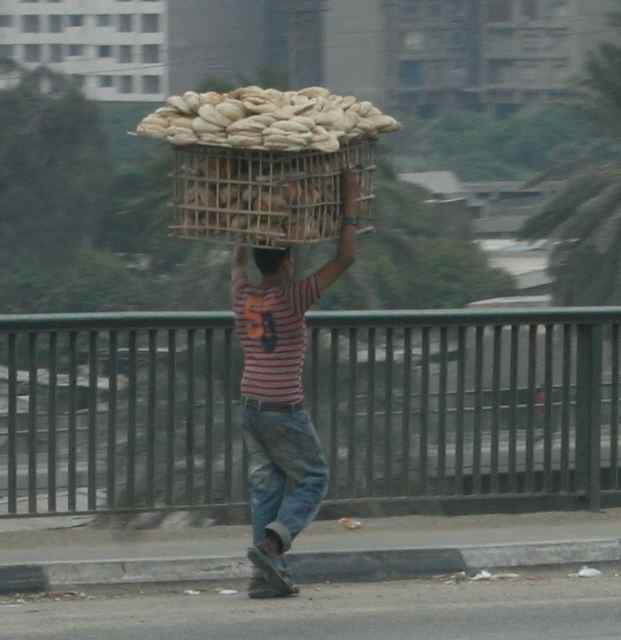
I have actually taken to bringing my camera with us because you just never know what you’re going to see along the way. Today included a GREAT bread seller, no bicycle, but he gets the award for highest stack. And for some reason he was walking along the highway, which I can’t imagine would produce much opportunity for sales (without a bit of traffic conflict).
There are always the lovely shuttle busses to avoid at ALL cost (they’re truly the craziest on the road). And this one was spouting a rather toxic smoke.

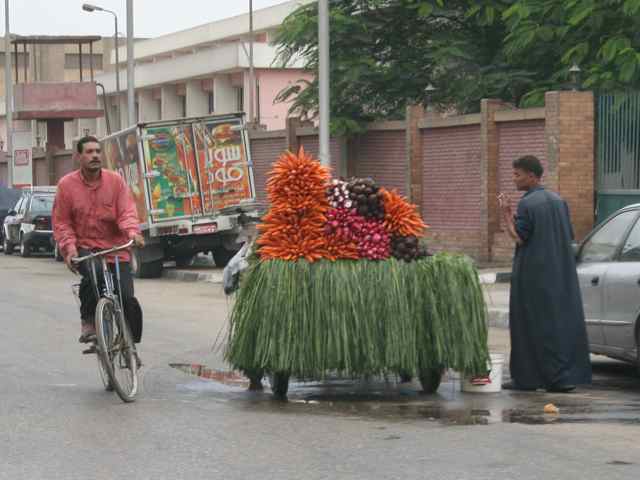
Veg sellers on the street always have what’s current and fresh, so apparently carrots are currently in season (I never really thought of a carrot season, comes from having them so readily available in nice little plastic bags, I guess).
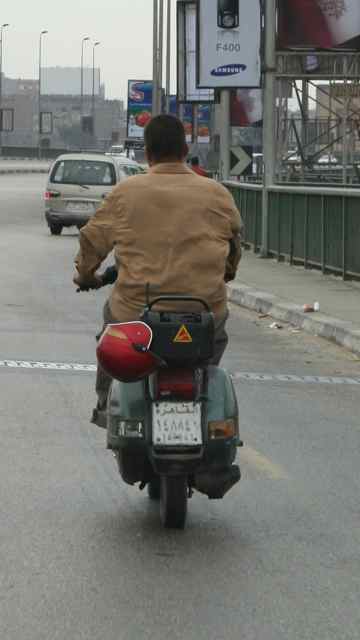
We saw a typical motorbike, but this one was unusual in that the driver had a helmet. Of course, he wasn’t WEARING the helmet, but at least there would be something readily available to scoop him into if needed.
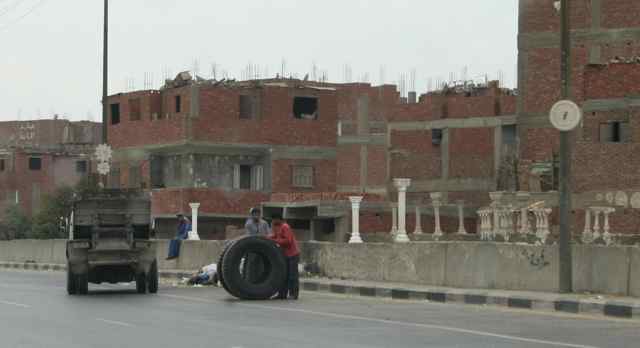
And apparently these gentlemen were trying to figure out either how to get these tires over the wall behind them, or across the 8-10 lanes of traffic on the Ring Road. Good luck, either way!
This morning we trundled down to Maadi around 10:00am and traffic was great – barely there at all. Depending on when you go, traffic can be lovely and light, or typical and exhausting. The issue today arose when we got to the commissary, which has recently changed its entrance. With the change has come a lot of headache, so much so that we waited for 20-30 minutes today just to get into the complex and the commissary. It’s supposed to be a safety thing, and while I respect their intentions, allowing a queue of cars to build and build, doesn’t promote safety, at all. I think after today there will be a lot of heated emails sent on Sunday (our Monday of the week). So despite the lack of traffic, our shopping trip still took 3 hours door to door. Of course, we did also buy a LOT more than we usually do, with the intention of not going again for two weeks. I may have to supplement our fresh fruit and veg with local options… we’ll see how things go.

One bit of excitement on the way home was the fact that we had to collectively figure out how to turn on and off the windshield wipers… because it was actually raining! Now, downpour it was not, but enough rain was falling that we did have to use the wipers for more than half the trip home. Ron was eager to get home and off the roads, as rain tends to muck up things even moreso than normal (not only with literal muck, but Egyptians don’t get much rain, so they don’t know how to drive on suddenly muddy and slick roads). We made it home without incident. But even later in the afternoon it rained again and was tapping on the overhang of our windows. Chuckles didn’t know what to make of it and approached the window as if the Boogeyman himself was tapping (we do enjoy our feline torments).

We have had two recent mid-week mini-drives, by me, at night. Yes folks, Julia has driven in downtown Cairo at night – and found herself laughing out loud as she did so (which is better than crying as it doesn’t blur the vision). Ron called one evening to say that our kitchen trashcan had finally arrived but it was obviously quite a big box. He asked if I’d feel comfortable driving the car to the embassy to get him, the box and our friend Ben. I said sure (never one to really think things through right away).

I got out of our compound just fine, through the gate at the end of the street (manned by the ever-present Cairo street guards), then slowly, ever so slowly, inched my way through a block of parked cars on either side, wishing I had a passenger who could snap in the side mirror to make things easier (yes, the extra few inches can make a world of difference). Then it was time to “merge” into the flow of traffic. Now, back in the states as the one who needs to merge, you tend to inch forward slowly knowing that someone will eventually let you in, or enough space will open up. Here, you just go for it, otherwise you will sit there and collect dust (until someone comes up behind you beeping incessantly). So, with a bit of a laugh, I just floored it and fell in line. Cairo traffic is like a flow of mercury, absorbing mercuric bits along the way as it releases bits elsewhere, but constantly in motion.

Relying on the “Care only about your front end” adage, I drove with confidence, only rarely glancing in my side mirrors to see who might be there and may try to speed up and swerve in front of me. Being able to read other drivers is key. All was good until we got to the Lion Bridge, when 4-6 lanes of traffic (lane being a very loose term as you make your own) merge down into 2-3, and as happened this night, there’s often a stalled car somewhere along the bridge, adding to the fun.

I made it to the embassy without a scratch (that I noticed) and gathered my husband, trashcan and friend. Surprisingly neither of them offered to take over the wheel, so I drove home. At first, I was quite pleased that they felt comfortable enough with me driving, but then I realized that they felt too comfortable and were discussing the possibilities of the Julia Taxi being on call for other nights. I nixed that one. Though a few days later I did do the journey one more time as another few large boxes had been delivered (cat food, bedding, etc.). But it is nice that with each foray, the confidence does grow – oh, and we finally got our taillight guards and front end heavy duty black metal guard grill installed, so anything remotely pliable, like a human, should just bounce off without hurting the car too much.

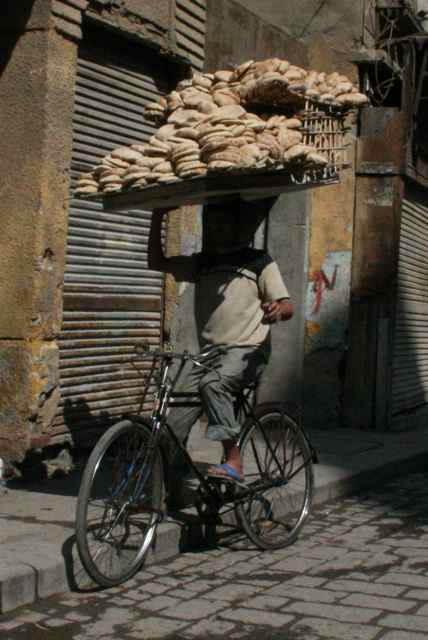
Double-Decker Bread Bicycle!

I just had to share this photo I captured of a double-decker bread bicycle from my recent “Walls of Cairo” tour through the Khan. I’m still writing up the tour, but since this wasn’t a medieval relic, I figured I could share it separately.

(I wonder why I’m so fascinated with all of the ways to carry items on one’s head? Then again, why wouldn't I be?)

Double-Decker Bread Bicycle!

I just had to share this photo I captured of a double-decker bread bicycle from my recent “Walls of Cairo” tour through the Khan. I’m still writing up the tour, but since this wasn’t a medieval relic, I figured I could share it separately.

(I wonder why I’m so fascinated with all of the ways to carry items on one’s head? Then again, why wouldn't I be?)

Taxi Insights & Happiness in Ignorance

There’s a very popular book here in Cairo that’s being pushed in every bookstore and shop called “Taxi” by Khalid Al Khamissi. It’s a collection of stories from Cairo taxi drivers. I read it this weekend (Ron read it months ago, well at least the first few chapters). I was fully expecting to finish it feeling sorry for taxi drivers, feeling guilty for getting frustrated, just overall empathizing with their lot in life. While there’s no question I empathize with their struggles, I also came away feeling more concerned than I ever have been about being a female and an American.

Now it has been a concerted effort on my part to keep myself insulated (and blissfully unawares) of the level of anger against America throughout the rest of the world. And luckily, my interactions with foreigners have all been relatively pleasant and apolitical. However, reading someone else’s words as they rail on about how much they hate America is disconcerting. No surprise, but there are a lot of people in this world who see America as the be all and end all of evil. Now, is this something they would typically bring up during a quick cab ride? Probably not. And I do realize that the majority of people I interact with have radically differing views and beliefs than I do on a whole range of topics (I am under no dissolution that if Cairenes were merely presented with tofurkeys, they would instantly adopt vegetarianism as the Egyptian doctrine), but luckily it does not mean that we cannot interact in a cordial business-like manner. I think the most frightening part is realizing that this hatred is not just from outcasts and lunatics in desert caves, but it held by everyday people. It just brings it much closer to home.

Even more frightening, however, was the attitude towards women and girls that was expressed by more than one driver. Now, I believe they are a definite minority (or maybe I just really need to believe that) of religious extremists (I’m assuming Islam, but since it wasn’t specified in some cases, with no Qur’anic quotes, I won’t make a blanket statement). But the level of hatred and distrust and true venom against women was so blindly ignorant as to be dangerous. The “Madonna-whore” complex doesn’t even begin to address their psychotic beliefs. It hails back to the days of the Salem witch trials, and was a bit like reading KKK literature. And these comments were never about American or western women, they were just about women in general (even their own daughters). These men are equal-opportunity scathing toxic misogynists.

A friend who read it, also said she was surprised by her reaction. She came away feeling like it vindicated her secret thoughts that she was always being scammed. She said it not only confirmed these thoughts, but made her realize that scamming and scheming is pervasive throughout Egypt, regardless of position, title or nationality. In fact, the book basically presents it as essential. The book told of how police threaten the drivers, who then pay them off so as to not receive a ticket; and how bribes have to be given in order to get your license renewed, or even get the correct forms; how lost paperwork can be found or instantly recreated with a money transfer. It really is amazing and I’m coming to believe that the chronic bribery that goes on has become so commonplace that it’s not even recognized as being corrupt.

Now, there were also interesting stories in the book, and it’s obvious that driving a taxi in Cairo is never anyone’s first choice of how to make a living. Most drivers are barely scraping by, or this is their second job of the day, and even still they’re barely making it. Most lease their cars from the owners, so some days they don’t even make enough to pay for the lease. Then they’re presented with new traffic laws, such as the most recent ones which require a seatbelt and a reflective hazard triangle. On the surface these sound reasonable. What I learned was that when a car is imported into Egypt, seatbelts and air-conditioning are considered luxury items, and the import taxes are so astronomical that people actually manually remove both before importing. So now seatbelts are being sold on the side of the road. And drivers said that before the law they were 50LE, after the law they’re 200LE (~$40). And drivers aren’t stopped to see if they have a working seatbelt, it just has to be draped over them. Ron and I both have had drivers tell us to just pretend to wear it, as it drapes over us with the metal end clanking against the emergency brake because there’s never (almost never) a clasp to actually attach it to. It’s all just such a joke.

Here are some of the statistics that the book presented:

> 80,000 taxi cabs in Cairo
> 250,000 taxi drivers (I think a special “commercial” license is required)
> On average, a young man starting out in the police force makes 350LE/month (that’s equivalent to ~$70 – you can see where and why the bribe demands start)
> The average college-degree accountant earns 350-450LE/month starting out (~$70-90)
> Rent and utilities for a family apartment is 150LE/month (~$30) [Sad realization: same cost as my spice rack from the Black Welders]
> Renewing a taxi driver’s license is about 470LE (~$94), without bribes

So facts like these do bring things sharply into focus. This is a very poor city and the people are definitely struggling. I guess I need to just accept the mechanics of this economy. I can’t change them; I wouldn’t even know where to start. But I can’t deny it’s frustrating. And despite reading in black and white the hatred that some people have, I’m not going to let it affect me. I can’t. Then they win.

Green bits in Zamalek

I’ve written the following for the embassy newsletter. Typically, my articles for them come out of blog postings, but are edited to remove any possible offensive comments (I was a little worried about my Fish Garden article, which I toned down from my blog posting, but the editor’s comment was, “It’s tasteful but truthful.” So I guess it’s okay). But in this case, I wrote the article first, and figured I’d use it here.

The only added comment I’d make is that it took me a ridiculous amount of time to try to dig up the names of these gardens. Many maps don’t include them at all, some do but lump them all under Andalusian Garden, and other than Hurriya and Andalusian the others are barely referenced in any books or online sources. For being public parks that are between 50-100 years old, I am amazed at how little is known. But I guess that adds to their serenity. There is actually also another one in this grouping, with a really nice statue, but I can never catch it when the gates are open – except for today, when workers were bringing out heaps of dead branches and grasses, so maybe it’s closed for maintenance?

Anyway, here is my piece on the public parks of Zamalek (sans Fish Garden).

Parks Exploration, continued

For anyone who’s driven or walked to Zamalek and crossed over on the Qasr al-Nil Bridge (affectionately known by many as the “Lion Bridge”), you may have noticed some parks, or gardens, on your right along the Nile. But did you know there are actually four separate gardens just in that little stretch? And even more surprising is that each one is different from the others. So a nice and easy outing for an afternoon is to grab a camera, a snack and go explore the public parks of Zamalek, but take along a few pounds as the entrance fee to each one is 2LE.

If you’d like to explore them linearly then have the taxi drop you off by Henri Jacquemart’s lions in front of the Opera House on Zamalek. You can also avoid the whole taxi journey if you take the metro and exit at the Opera stop. But before hitting the Nile-side gardens, cross the street to the Hurriya Garden (this is an added bonus).

The Hurriya Garden (“al-Tahrir Gardens” on the Practical Guide map) was initially called the Ismail Garden when it was designed in the 1870s, and covered over 12 hectares. In 1952 it was renamed “Hurriya” (Freedom) and had been reduced to only 2 hectares (about 4 acres). In addition to the wide paths and tall shade-producing trees, it also houses ten statutes, including Talaat Harb and Hafez Ibrahim, and six Latin American liberators.

Crossing back over Midan Saad Zaghloul (always an exercise in sprightliness), you enter the Andalusian Garden gate from just beside the left lion. This is the only park, among this grouping of four along the Nile, that has direct access to the Nile (whether that’s a positive or a negative, is up to you). It was originally designed as a gift for a royal wife in 1929, but was opened to the public in 1935. It’s also more bench and concrete oriented than the other gardens, which tend to highlight more of the actual nature side of a garden. But there’s no doubt that this is a favorite of the courting couple sect, with a bounty of benches and nice Nile breezes (and only the occasional nosy expat).

Walking around the corner following Al-Gezira Street along the sidewalk, you come to another gate. This is for the Arab Garden, which is the smallest of the gardens. Here you find a nice collection of towering palm trees, stone pathways, some statues, chairs and tables, well-manicured grounds and quaint old-fashioned lamp posts.

Continuing on up Al-Gezira Street, just under the automobile on-ramp for Sixth October Bridge, you find two more gates. These last two gardens are definitely the least populated, though there are always couples to disrupt, but I thought they both were well worth the extra steps (with one housing a little-known artifact from Ramses the Great).

The first gate leads into the Pharaonic Garden. During the day it’s populated with just a spattering of courting couples and some maintenance men pruning, trimming and planting. There are some tables and chairs set up at one end under archways, and throughout there is a nice collection of statues positioned along the paths. The pools and fountains have some stagnant water, but regardless there are flowers and bushes and this is the only place in all of Cairo that I have seen butterflies. The hidden jewel to this garden is the obelisk positioned along the Nile, which is one of a matching set, with the other being at the Cairo airport. These two are from Ramses II (19th Dynasty, reigned 1279-1213 B.C.) and were brought here from Tanis in 1958, and are said to be the only obelisks in Cairo.

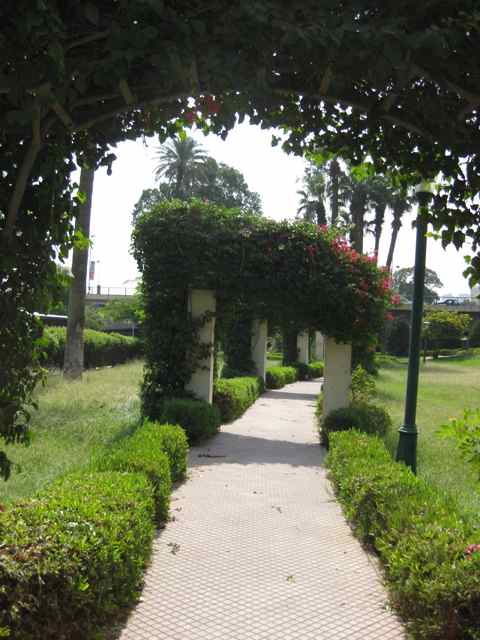
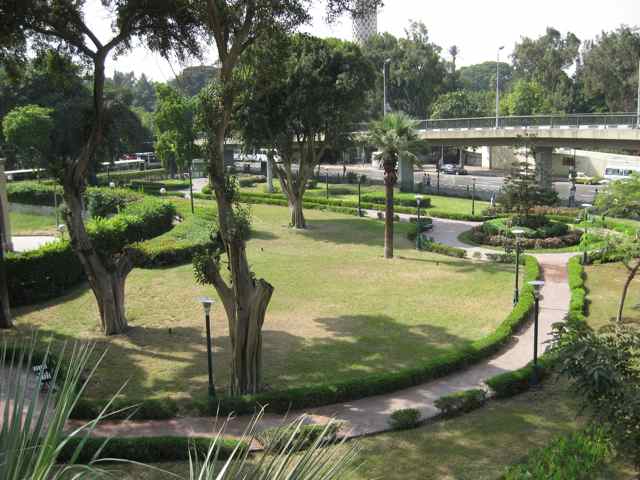
The last park in this little collection is River Garden, located just across from the Pharaonic Garden. As per most of the others, the paths and plants are manicured, with nice flower assortments, landscaping and large grassy areas. The grounds continue on under the Sixth October Bridge, to the other side which showcases arches and pergolas covered in flowering plants and vines, with nice little private benches, a gazebo and a quiet circular path. There is active maintenance work occurring, but none of it seemed to bother the couples or the egrets milling about.

I have to add that the names of the gardens vary from source to source, but I tried to choose the ones that seemed to have the most “votes” (from books and online sources). A lot of the details I’ve presented here are from Lesley Lababidi’s book "Cairo’s Street Stories," which I would recommend for anyone curious about interesting and unknown facts, tid-bits and areas of Cairo. Regardless, if you start at the lions on Zamalek and wander north, and hand out 2LE every time you find a gate, I’m sure you’ll discover some noteworthy finds, and may make a few friends along the way (depending on who you give the 2LE to).