Italy - Day Seven (Hey, that's the Pope!)

NOTE: I apologize for the blog absence of late. We've had houseguests and I've been traveling, so the blog has been put aside. But let me finish up Italy and we'll get back to the chaos of Cairo.
**********************************************
ITALY - Day Seven (Hey, that's the Pope!)
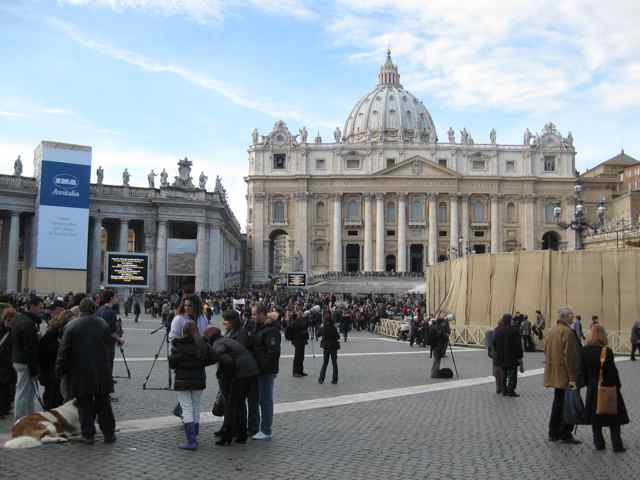

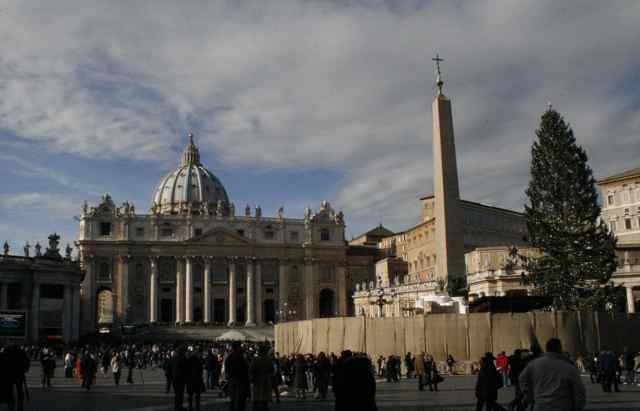
Sunday morning in Rome -- gotta see the Pope, right? We walked down to St. Peter’s Square and after waiting a little while, amusing ourselves with some fabulous people watching, Pope Benedict the 16th appeared at his window in the sky and we were privy to his weekly prayer service in which he offered blessings in at least Italian, English, Spanish, and French to a very enthusiastic crowd.

Since the weather was beautiful today (yeah!), we decided to walk over to the Castel Sant’Angelo, which we had passed repeatedly on our way to and from the Vatican. It is located on the banks of the Tibre and apparently started out as a mausoleum in 128 AD, however has also provided a place of safety for popes since 1277 AD due to an underground tunnel between it and the Vatican. For whatever reason, however, it was closed today.
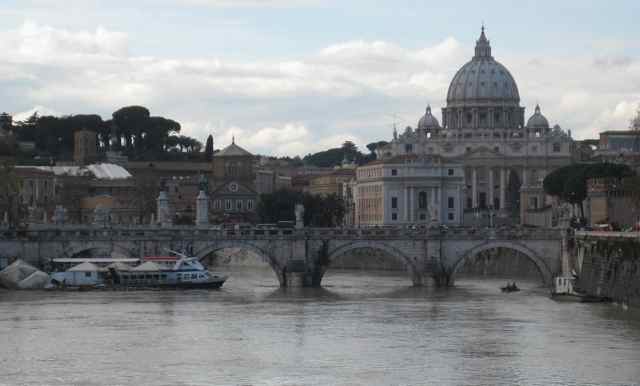
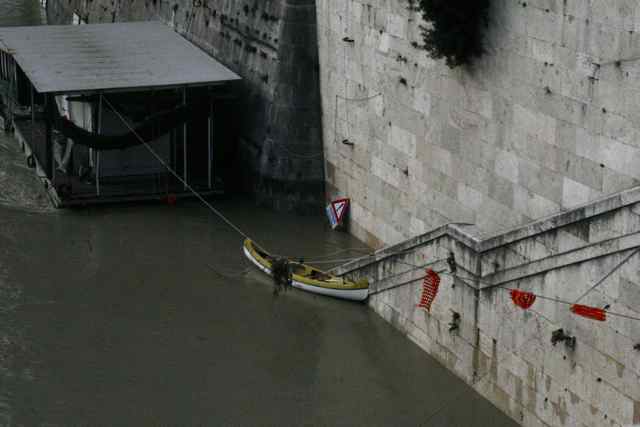

We took in the floodwaters of the Tibre as we crossed the bridge, looking for a lunch spot. We found a great trattoria, all locals inside, and had a wonderful lunch of homemade pizzas.
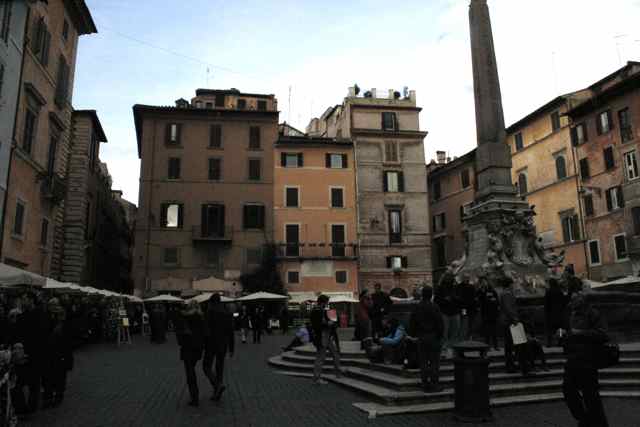
From here we walked to the Pantheon, as we were drawn to it almost daily. And along the way I convinced Ron (with great arm-twisting, I might add) to stop and share one more gelato. Yes, it was cold, but at least it wasn’t raining.

We then found ourselves back in the Pantheon square, full of Romans, tourists and even some live music. The latter had great, and immediate, effect on Ron who found himself moved to perform his robot-dance in the middle of the square. Why can't I remember to carry a video camera?!

We continued our walk, determined to find an obelisk mentioned in the guidebooks that had an elephant at its base. It was a mere block behind the Pantheon, but we had managed to never see it during our previous amblings. It stood in front of a huge gothic church that had brilliant blue ceilings and ornate gilding.
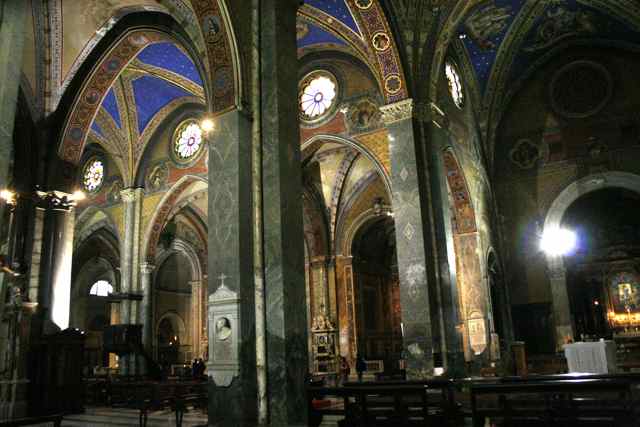
We made one more trip to St. Ignatius di Loyola so I could grab some pictures (there was a mass when we’d come earlier), and then hopped on a bus to find Basilica di San Giovanni in Laterno. We had noted a priest on the bus and assuming he might lead us to our destination we followed him off the bus. Well, this was no ordinary priest, he was apparently a former Olympic speed walker, so we were soon left in his priestly dust. But we huffed our way up the hill and in a few blocks found ourselves at San Giovanni.


The Basilica di San Giovanni in Laterno was founded in 313 AD by Constantine and was the first basilica (large church given ceremonial rites by the Pope) to be built in Rome. It also served as the Pope’s primary residence until the late 1300s. While it was certainly large, gilded and impressive, we were both very taken with the octagonal bapistry next door. We quietly imposed on flurries of Italian families who had either just finished baptisms, or were about to begin them. But the feeling of joy and family was incredibly strong and Ron and I each were very moved by their presence. The mosaics, dating from the 5th and 7th centuries, were particularly stunning.
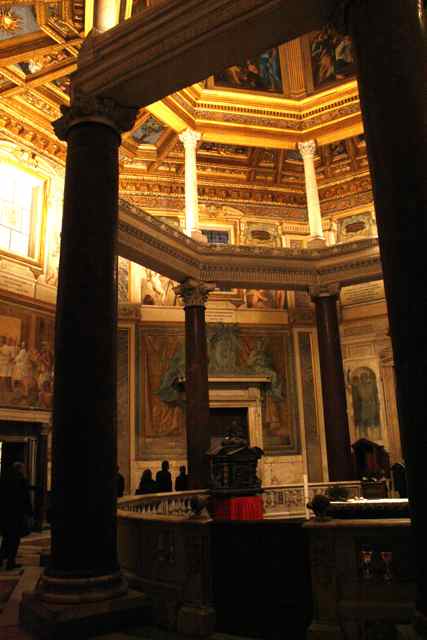
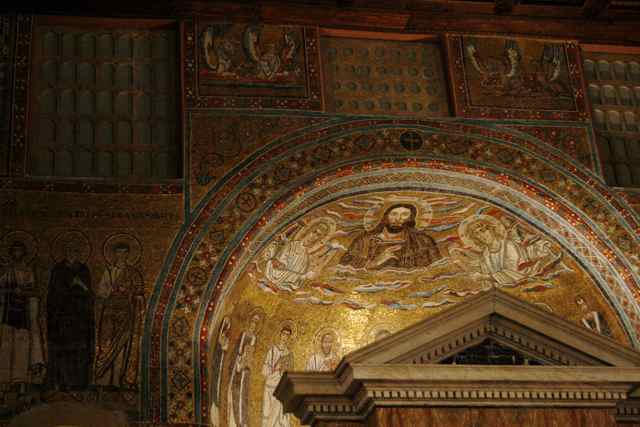

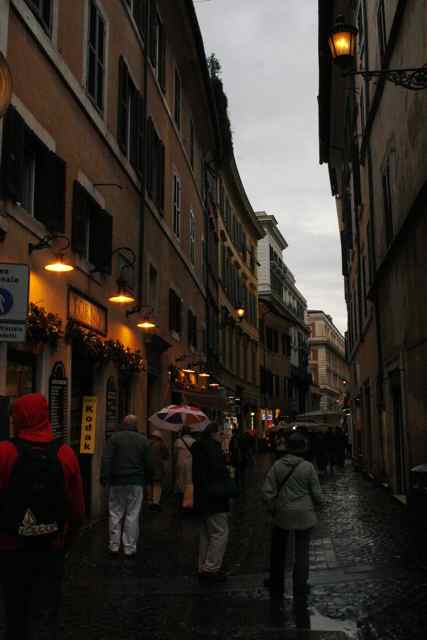
By this point it was getting dark so we hopped on another bus to take us back “home.” Along the way we came upon the Colosseum, and in a spontaneous flash we dashed off the bus to get some night photos. We then decided to take a romantic walk in the moonlight, past the Arch of Constantine, and on to the Circus Maximus, which, in its 1st century heyday was Rome’s first stadium, seating 250,000, but currently is merely a large grassy bit with Roman rubble pieces.
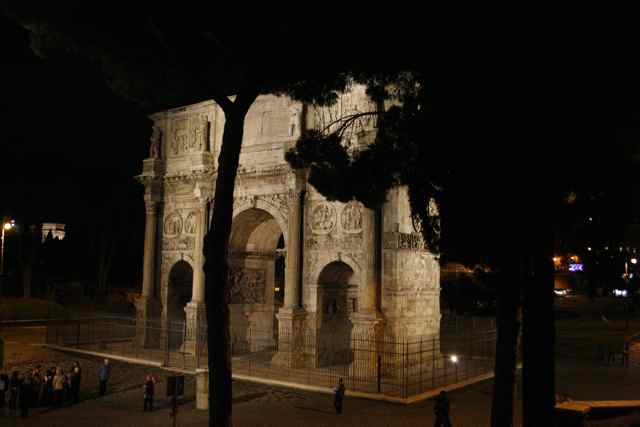

We finished out the day with dinner at a local restaurant a few blocks away from our hotel. Other than sharing it with an exuberant group of American high-schoolers and their chaperones, we had a nice meal, complete with my last cannoli.
Italy - Day Six (hey look, sun!)

Glory of glories, the rain has stopped! The sun is out and we are on day six! Even better than the glorious weather, my dear husband, feeling a rush of romanticism kindly compared me to his pineapple pastry at breakfast – saying something about being sweet and how the yellow pineapple filing reminded him of my hair (sticky? Chunky?). Now, if we go by intentions alone, he gets full credit. But if we throw in a dash of common sense, he only gets half credit (since he didn’t apply any).
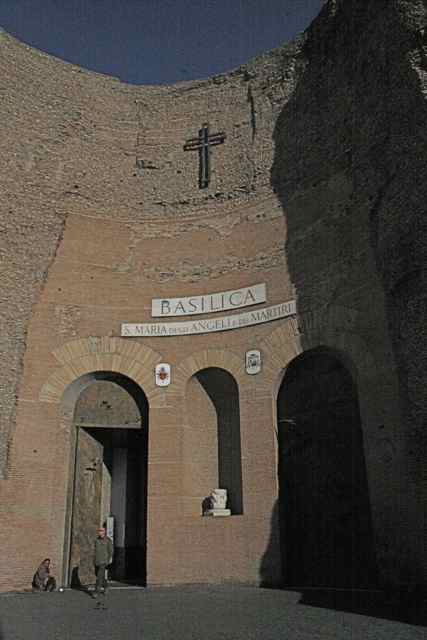
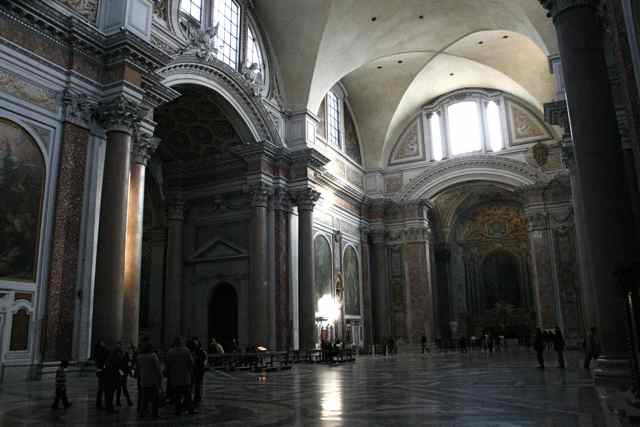
We started off the day at the Basilica of St. Mary’s of the Angels and Martyrs, which was located right across from Termini Station. Externally it looked like a pile of Roman ruins, but inside it was enormous and cavernous and, as always, impressive. It was originally designed by Michaelangelo in 1593, however only the vaulted ceiling remains from his initial plans.


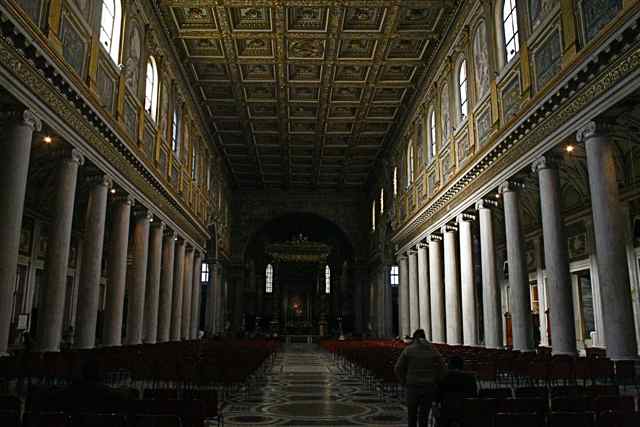
Next, we walked to the Basilica di Santa Maria Maggiore. This amazing structure was built in the 5th century with the tallest belfry in all of Rome (reaching 246 feet). It still has a stunning border of glittering mosaics dating from the 5th century, however my photos just couldn’t capture them well (too high). This was a really spectacular church, and in addition to the amazing architecture and artwork, it was also the church where Ron’s cousin, Mark, was ordained as a priest in 2005.


Afterwards, we wandered around a bit and found ourselves in Rome’s Chinatown. I popped into one small store that seemed to sell hats and beads, and grabbed a simple winter hat, fearing what the weather would be like in Florence being farther North. We found a trattoria for lunch where the food was excellent and I had three ravioli each the size of a salad plate!

Ron had been reading in the guidebooks about catacombs in several churches across Rome. Apparently you can visit most of them, with a guide. However, with the pouring rain and flooding rivers, we weren’t sure how accessible they would be, but we decided to check out northern Rome and the Church of St. Agnes. We hopped on a bus and headed north through some lovely tree-lined streets. To set the mood for the quintessential Roman bus ride (or MGM musical), we even had an accordion player on the bus playing “That’s Amore.” It was perfect!!

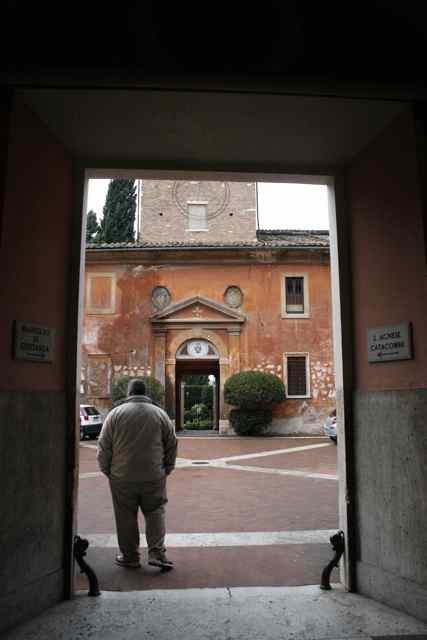
We hopped off approximately where we thought it should be, wandered the street a bit and finally asked a very nice policeman who directed us to the building we had passed two blocks back. The Basilica of St. Agnes is a 4th century medieval church, complete with a complex including a mausoleum, Bocce courts, a small café, football (soccer) fields, and a bathroom that has a temperamental light (throwing one into darkness at highly inconvenient moments, instilling flashes of momentary panic).

We explored the Basilica of St. Agnes and tried to get a guide for the catacombs underneath, but we overheard a rather grumpy priest tell some other visitors that the guide wasn’t there today so no one was allowed in. Well, blah.

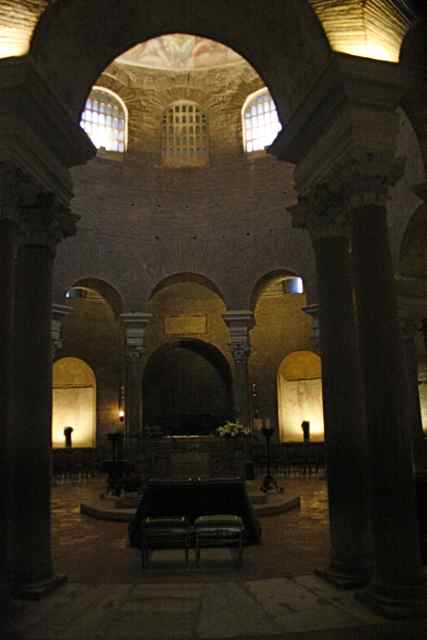
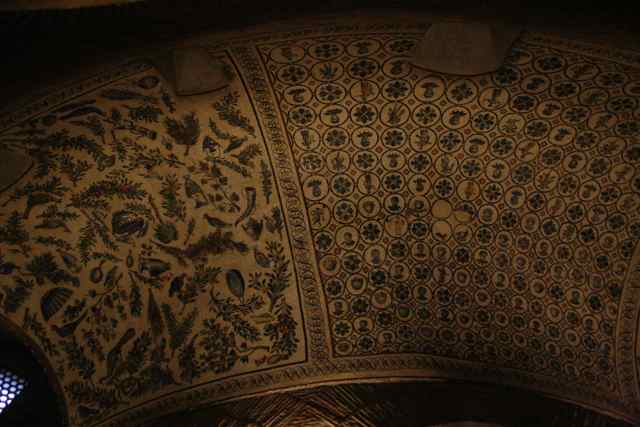
At the other end of the complex was the Church of St. Constanza, which was built by Constantine as a mausoleum for his two daughters. It was circular with a simple design and had stunning mosaics dating from the 4th century. This was our first experience with the pay-for-lighting machines. As we entered the mausoleum there was a small box on the left that looked a bit like a silver pay telephone, minus the actual phone.

They require exact change, so we opted to hit the café for a coffee and some coins first. We walked around the center football field and tennis courts, passed the covered Bocce court, and into the little café. I proceeded to have my misadventure with the bathroom while Ron got me a cocoa and himself an espresso. I returned to find him sitting at a folding table in a room with 20 Italian men playing cards. We apparently had found the Italian version of the Kiwanis Club. Ron drank his espresso, which he was loving where ever we went, and I found that other than my Giuliani’s Dixie-cup cocoa, the rest of them were getting progressively thicker. To the point where this latest cup basically required a spoon. Hot chocolate pudding. Interesting concept.

So, with exact change in hand, we returned to the mausoleum and paid for the electric light. It really was spectacular and the mosaics lit up nicely.

By this point it was dark, and raining. So we ran down a few blocks to a bus stop and grabbed a bus back to the hotel for a quick rest. We had an exceptional dinner tonight, probably the best we had in Rome. And afterwards we walked to Giuliani’s where we partook of pastry delights (I had my mostest favoritest canolli), espresso and some Limoncello until they closed down at midnight.

Italy - Day Five (gee, it's raining)


I don’t know about the rain in Spain, but I can tell you the rain in Rome is relentless. No surprise, but by this point we were starting to feel the effects of a lot of rain, combined with no umbrellas, no hats and I only had heavy scarves. So our first stop today was the shops in Termini Station where we bought a basic men’s winter hat for Ron, who was feeling a cold building. We bought more bus passes and hopped on the 40 bus. However, we knew something was amiss when it veered off onto a side street, started heading in the opposite direction and Italian chattering rose to a clatter. The elderly lady Ron gave his seat to had been talking at length to (at?) us since we left the station. She didn’t seem to care that we couldn’t converse with her other than with smiles and nods. Like a lot of the other passengers, we opted to get off at the next stop, which ended up being near Triton’s Fountain.

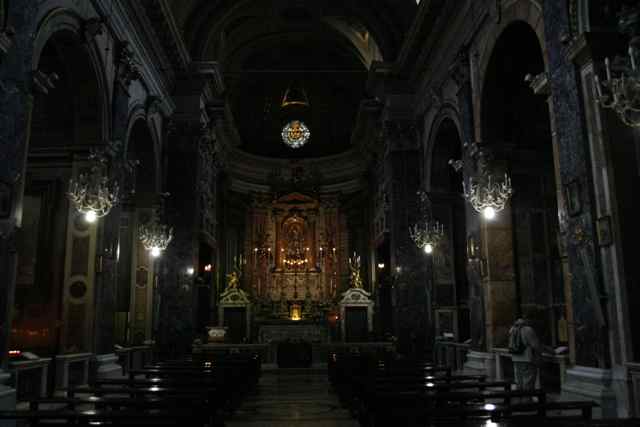
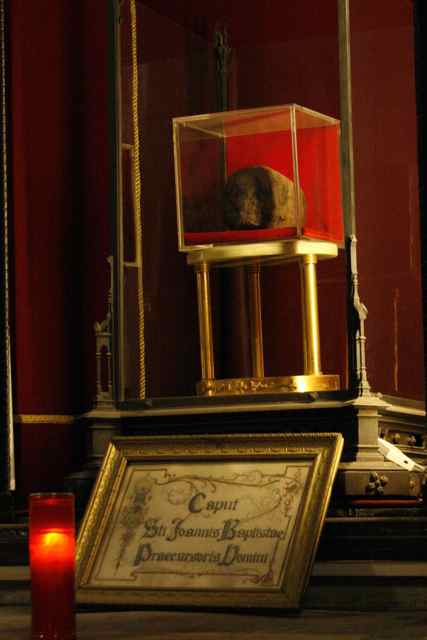
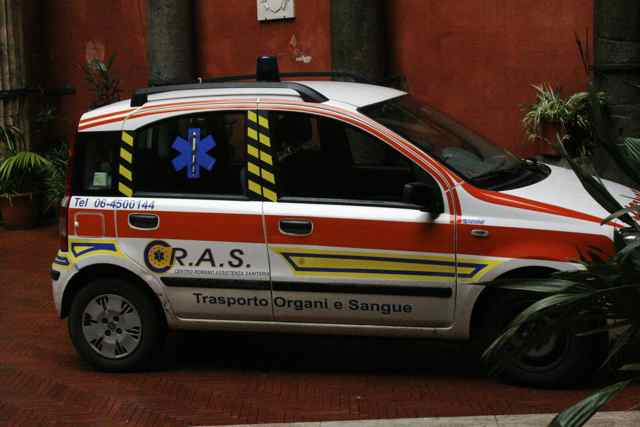
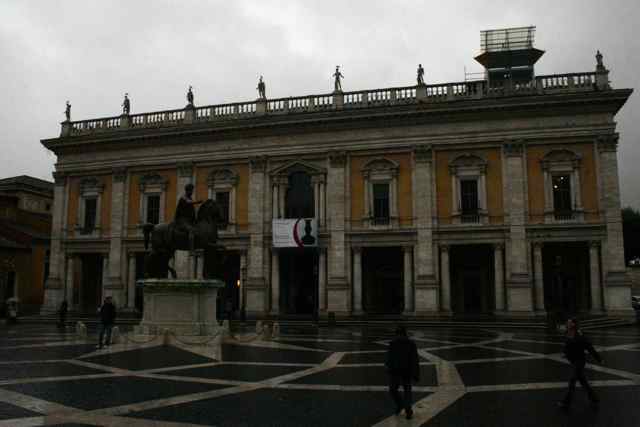
We were heading for the hidden-atop-a-hill Capitoline Museum (again) and decided to just walk as it wasn’t raining at the moment. Along the way we stopped in two churches, Church of San Silvestro in Capite and Madonna of the Well. Madonna was a beautiful ornate church (see above). Silvestro (below) was a small, but equally ornate, church and as we were exploring Ron found a side nave with St. John the Baptist’s Head on display. Really rather astounding! Then as I was wandering outside of the church a small car drove in labeled “Blood & Organ Transport.” Hmmm.


One thing that I noticed throughout Rome was the abundance of nuns and priests. Not surprising, really. For whatever reason, I got great delight out of seeing them in everyday life situations. My favorite was seeing a nun (in full habit) perusing the iPhones in a store window. Later, a priest got on the bus and was happily listening to an mp3 player that was tucked safely inside his North Face jacket. And somehow a phrase got caught in my head, so every time I saw a nun, which was frequent, my brain would say, “Nuns kiteer!” (which is “A lot of nuns!” in Arabic.)

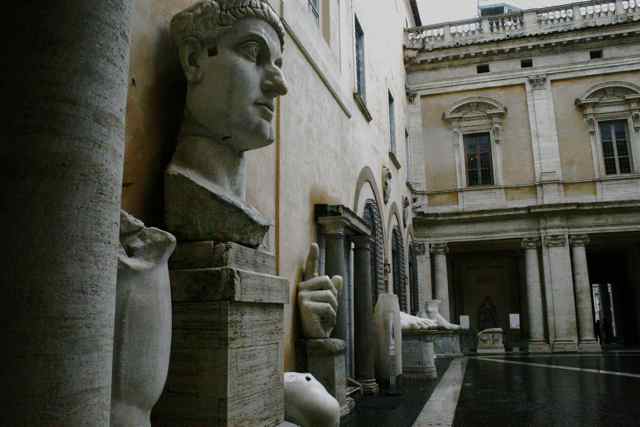
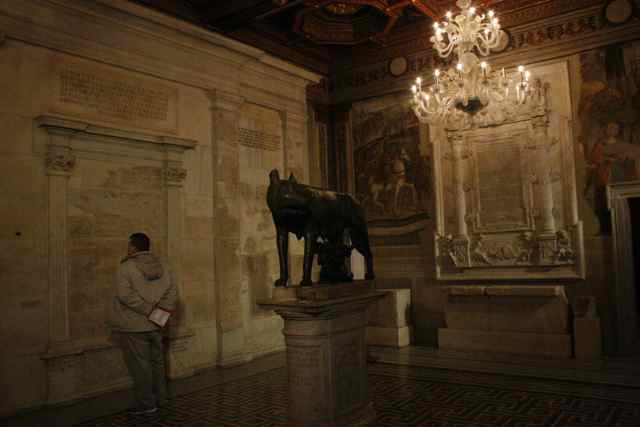
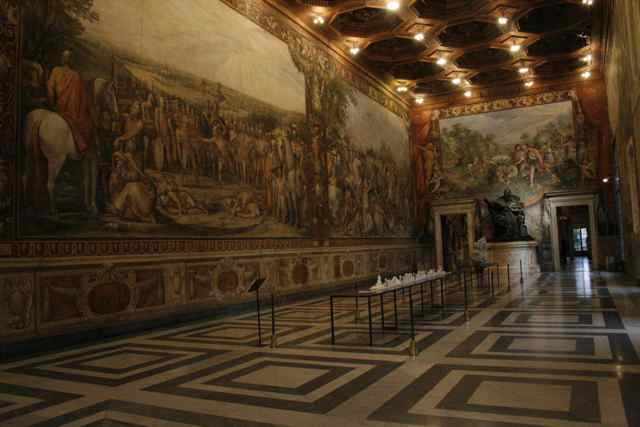
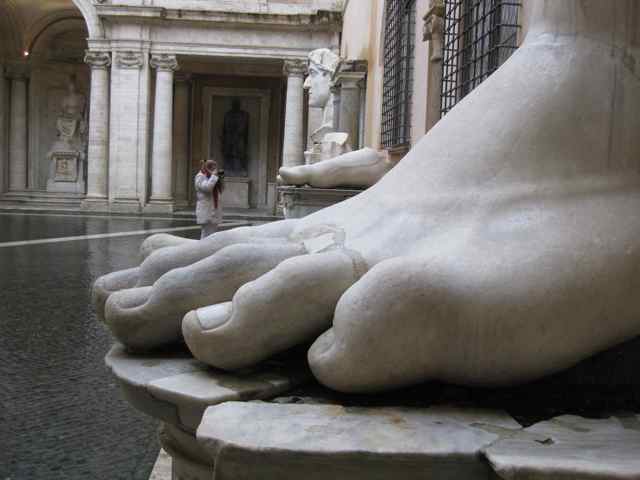
We finally made it to the Capitoline Museum. It was raining again, cold and dreary. And as luck would have it, they had marble heads! But their collection was a little broader in scope, as they also included marble feet and hands. Their exhibits were really exceptional and they had some pieces that dated before Christ. The one thing that was a little off, however, was their decision to inter-mix some modern pieces. It's really rather jarring to be mentally enmeshed in thousand-year-old art then be confronted with a mouth-couch.


Tonight was the concert at St. Teresa’s. The concert was a single pianist who was very good. I was hoping, considering the season and all, for a Christmas concert, or at least a song or two. But that wasn’t on the agenda. Oh well.

By this point in the vacation we were both doing a lot of passive language learning. However, from the beginning, I was adamantly determined to not speak any Italian. It’s nothing against Italy or Italians, but I know my brain’s limited capacity and for all the work I’ve put into Arabic these last several months, I knew that as soon as I opened the doors to my Italian lessons from the University of Cincinnati almost twenty years ago, my Arabic would slide right out and be lost forever. Ron’s brain is different (and there are many many examples of this), and he can keep languages safely stored away for future use. Despite my not speaking, other than “Prego,” “Scusi,” and “Gracie,” by the end of the trip I did feel that given a year or two here I could pick it up much faster than my Arabic. With any luck I may get that chance.

We grabbed a bus home, tried a new pizzeria for dinner that turned out to be rather blah. The food was blah, the service was so-so, the décor was blah, the place was cold, and the dinner was topped off with a large glass of free liquor, which after tasting it we decided they were under strict instructions to get rid of, because it tasted like a licorice-prune concoction. Truly dreadful!

Italy - Day Four, Colosseum, Forum & Rain

Today was our “Enjoy Rome” tour of the Colosseum and Roman Forum, but that wasn’t until 2:00pm. So, despite more rain, we decided to head to the Capitoline Museum. We got off the bus where we thought the museum would be, and walked and wandered, and stopped and checked the map, and walked some more. We did manage to find an old synagogue, but just could not find the Capitoline Museum! (We learned later in the day that the museum was the enormous building on the hill from which we could have watched our aimless trek about in the rain. I think the pouring rain just prohibited us from looking up.)

So, abandoning the museum for now, we found ourselves at the Tibre River which was flowing furiously. We wandered on to Tiberna Island, and came to a small church (which is not hard to do in Rome, where there are more than 900 churches). This was the Church of St. Bartolomeo. It was built in the 10th century, allegedly over a Roman temple honoring a Greek god of healing. The alter currently holds relics from St. Bartholomew the apostle, and the side alters honor martyrs of the 20th and 21st centuries who fought against communism, the Nazis and other conflicts in Europe and Latin America.

After this, we continued on over Tiberna to the other side and found ourselves wandering through some small back alleys. We came to a small deli shop that sold meats, cheeses and pastries, but also offered sandwiches and pizzas and lunch items. We decided to squeeze in with the locals and we shared a piece of pizza before venturing out in the rain again.

After a fairly adventurous hike, which involved a lot of stopping and map-reading, asking police for directions, and hiking up to the front of the Capitoline Museum (finally), we met up with Valentina, our beautiful Italian tour guide, and the other five intrepid tourists, for our “Enjoy Rome” excursion. The tour was really good, and I’m definitely glad we did it for these sites in particular (so much history!).

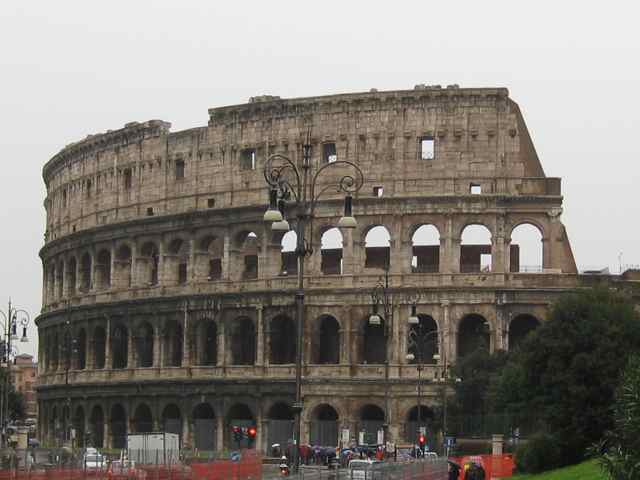
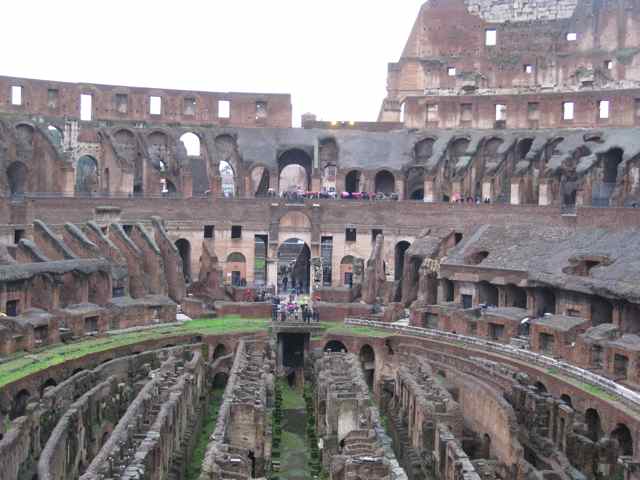
The Colosseum was built by Emperor Vespasian and inaugurated in 80 AD. It was built over the previous palace of Nero and was intended to be for the Roman people to attend annual 100-day-long celebrations. It seats up to 75,000 people (receives 4 million visitors a year), and has 80 archways allowing quick entry and seating. In its heyday, it had a wooden stage (covered in sand to soak up the blood from gladiators and slaughtered animals - lovely), with trapdoors and an underground network of rooms and cages. It also had a system involving 240 masts to extend an awning over the spectators to shield them from sun and rain.


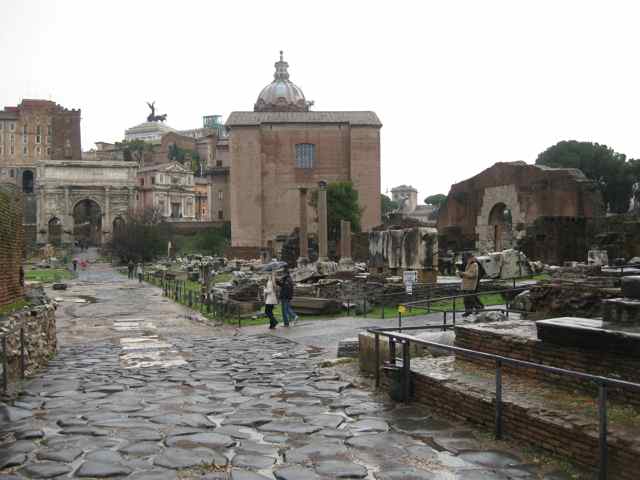
Next, we all trundled over to the grounds of the Roman Forum, which are really just a large plot of ruins. They are still conducting active excavations and continue to find things, layer after layer. The stones that made up the road we were standing on dated back before 1 AD. It was originally an Etruscan (pre-Roman) burial ground and was developed in the 7th century BC from which it became the center of the Roman Republic, where it remained in use until the 4th century AD. The history surrounding you as you stand here is amazing. We even got to see the site where Julius Caesar was cremated, and Augustus erected a temple around it in 29 BC (the temple was more like a lean-to currently, but it was still impressive).


We walked up in front of the Il Vittoriano. Known by locals as “the wedding cake” it is apparently not well-liked and considered too ostentatious (though in comparison to some of those Baroque churches, I’m not sure how they measure things). It was erected to honor Vittorio Emanuele II, the first king of Italy (who united the north and south into what we know as “Italy” today).

At this point, Valentina told us to be careful crossing the street. Ron and I just rolled our eyes. Yes, traffic in Rome is fast and furious, but unlike Cairo, they will actually stop for pedestrians, especially in crosswalks (we tested it). We wandered back through some side streets and came out at the Trevi Fountain! Yeah!! It definitely was impressive, and crowded! Despite the cold, and intermittent rain, Ron and I shared our first Italian gelato (yum!) and we even threw a coin into the fountain insuring a return trip to Rome (though we’re curious if the Egyptian piaster’s exchange rate will actually get us all the way here).

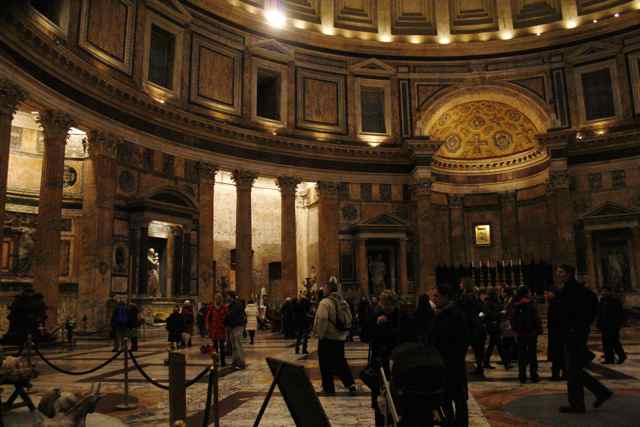
Our next stop was our old-favorite, the Pantheon. Excitedly this time the doors were open so we were able to actually go in. The current structure dates from 120 AD, however they have found remains of the original building from 27 BC. The dome above measures 43.3 meters in diameter, as well as interior height, and remains the world’s largest masonry vault ever built. The walls of the dome measure 5.9 meters thick at the base, and 1.5 meters thick at the top where there’s a hole measuring 8.7 meters in diameter allowing sun, rain and snow to enter in. (Yes, we sat there and watched the gentle Roman rain come in, which was actually quite peaceful providing you were warm and dry at the time.) The dome has been studied and using modern concrete it’s been determined that they could not replicate it without it collapsing under its own weight. The construction remains an engineering marvel and it’s said that Brunelleschi used it as a model for the Duomo in Florence (more on the ensuing panic attack later).


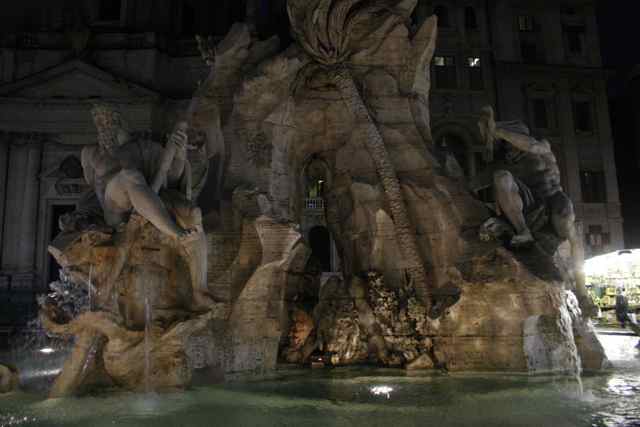
Our final stop on the tour was at Piazza Navona and the Four Rivers Fountain. At this point, Ron took the opportunity to pop into St. Teresa in Agony to get tickets for a benefit concert they were giving the following evening. While he did this, I wandered around and took photographs. At one point, as I was clicking away, a man approached me and held up his little finger, trying to get me to do the same. I smiled, but ignored his request and kept taking pictures. He tried again, looking ever so nice, albeit a little odd holding up his pinky like he was the Queen drinking a “cuppa.” I brushed by him, and didn’t think anything of it until later that evening when Ron handed me one of the free Rome magazines and told me to read about a local scam. Apparently men come up to women and girls asking them to hold out their pinky. If they do, then the man ties a cute little bow around it with a piece of string, and then within seconds, literally the article said seconds, they have a braided bracelet tied firmly around your wrist. As cute as it is, they are suddenly demanding money, sometimes 10-20 Euros, for the bracelet that you now cannot remove from your wrist (unless you carry a Swiss Army knife, which most of us avoid on trips involving airlines). So I’m quite glad that my inner caution kept me safe. But in general I think it’s a good thing to be wary of strange men approaching you with their pinkies in the air.

We hopped on the bus back to the hotel, where we warmed up, dried off and rested a bit before heading out to dinner back at Andrea’s, which we loved our first night. Ron had two glasses of the house red wine, which were much stronger than he had expected. So by the time we were walking back to the room, his burgeoning Italian had slipped back to basics and complaining about the wooden chairs at dinner, he muttered, “Butt hurto”. And I added, “Belly fullo.” At the hotel, he was futtering about by the elevator, so I muttered, “Follow the sound of my voice” in my baritone impression to get him to come to me, and as he came around the corner he said, “Did you hear that man?” Time for bed, dear.

Italy - Day Three, The Vatican! (long day, long post)


Today was Vatican Day!! As we were getting ready and packing our bags for a day of walking (though we truly had no idea just how much walking was on the agenda), Ron was going through the Italian phrasebook practicing his burgeoning Italian. By the time we left he had down pat, “I am here with my girlfriend,” and the equally important phrase, which I said was directly linked to the first phrase, “I don’t want a blood transfusion.” We were set.

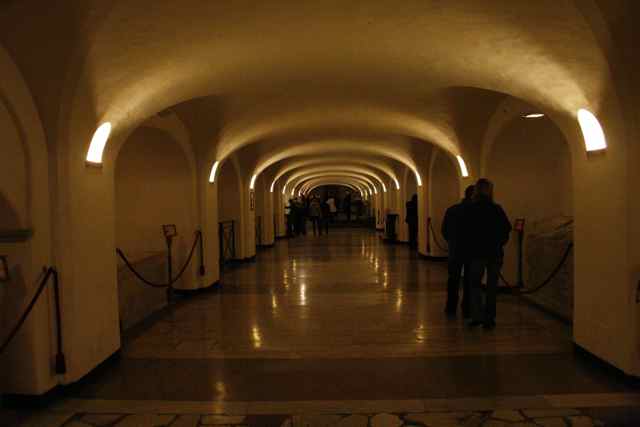
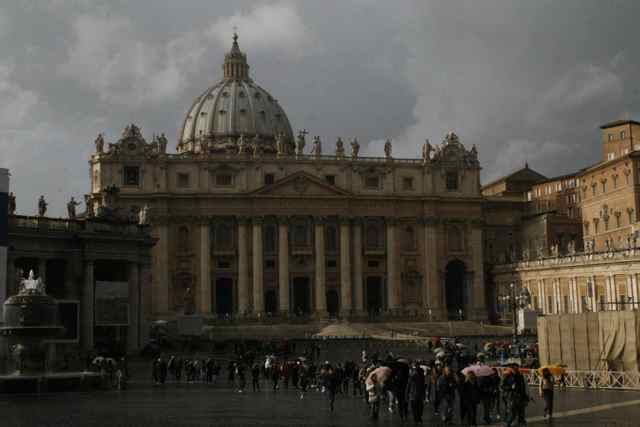
We grabbed the 40 bus which took us directly to the Vatican, sort of. We got off when it stopped and everyone exited, utilizing the sheep-method of travel, and then followed various nuns through the streets until we came to St. Peter’s Square. I think overall we spent at least six to seven hours exploring everything that was there and we could have spent days! We saw the grottoes underneath St. Peter’s Basilica, where many of the popes are buried, including John Paul II and even St. Peter’s tomb. In the 1940s excavations were conducted and bones were found. After forensic testing, it was officially declared that they were the bones of St. Peter, who was said to have been buried here between 64-67 AD. They are now housed in a very elaborate tomb and are apparently kept in special boxes designed by NASA.

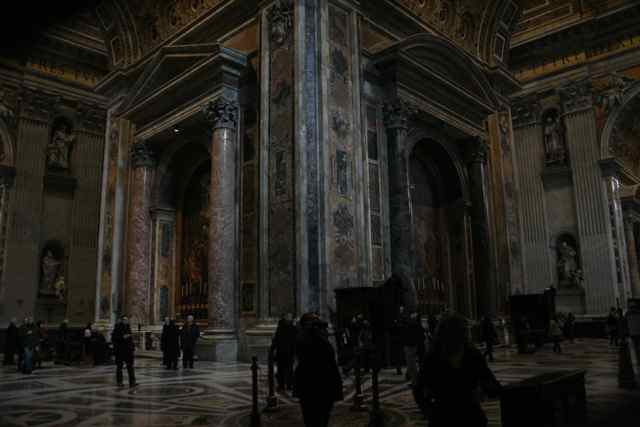
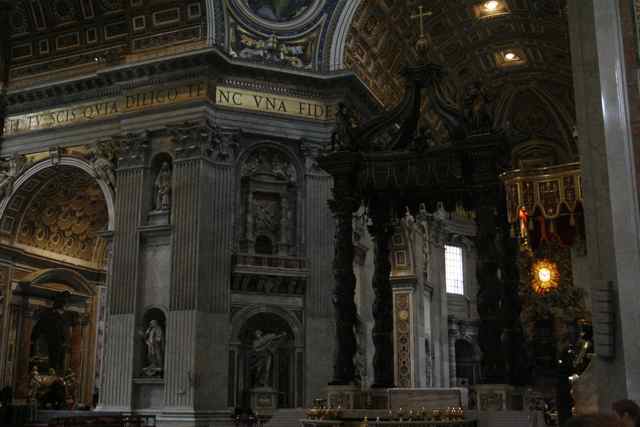
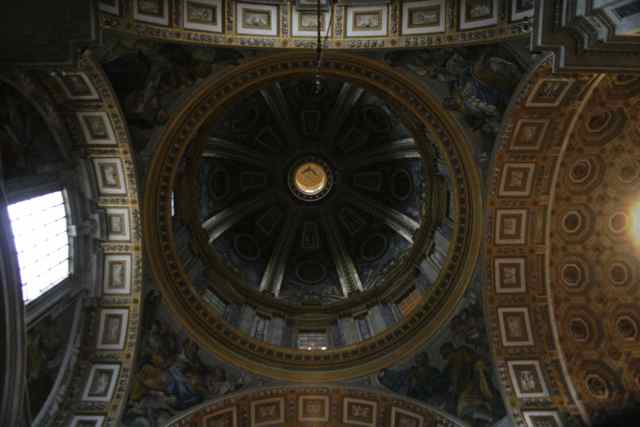
Constantine built the first basilica at this location in the 4th century, on the site of Nero’s stadium. It fell into disrepair and finally in 1506 Julius II hired Bramante to design and build the structure that stands today. It took 150 years to complete, and over that time many different artists were employed, but it’s most famous was definitely Michaelangelo, who took over the project in 1547, when he was 72, and designed and painted the impressive center dome. (He had painted “Genesis” on the ceiling of the Sistine Chapel in 1508, and “The Last Judgment” above the alter in 1534-1541.) Ever fitting with our vacation themes, our pal Bernini was the last artist hired to complete the basilica as well as St. Peter’s Square and colonnade in front. He also has countless statues and tombs inside. On a side note, you may notice in some of the pictures that there is an Egyptian obelisk in the middle of St. Peter’s Square. You’re not wrong. This 25-meter high red granite obelisk was brought from Heliopolis, Egypt (where we currently go to CityStars Mall) by Caligula (reigned 37-41 AD). In 1586 it was placed where it stands now, and took four months, 1,000 men, 140 horses and 44 winches to get it in place.

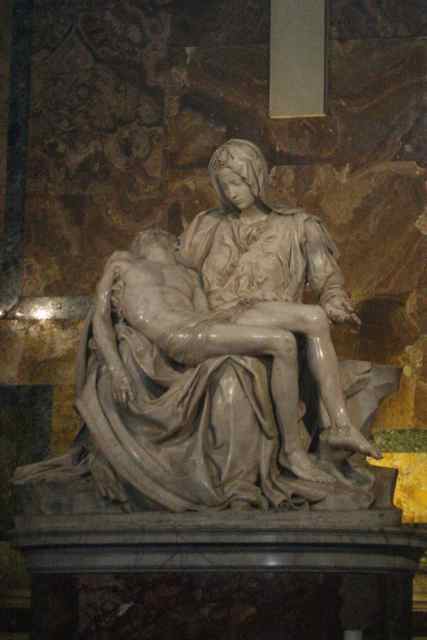
Inside the basilica there’s almost too much for the eyes to comprehend. It covers over 15,000 square meters, and houses hundreds of works of art, including Michaelangelo’s “Pietà”. This marble statue, carved out of one single piece of stone, depicts the Virgin Mother holding her dying son. They say that Michaelangelo himself chose the piece of marble to be used, and it took nine months to transport it to Rome. As we were standing with the masses admiring the delicate folds of fabric carved from marble, there was suddenly some commotion behind us and some secret-service-looking guys bustled through clearing the way. We stood aside and Ron whispered in my ear, “There’s General Petraeus!” The General dutifully admired the Pietà before being whisked away to the next stop on his tour.

We continued on our own, trying to absorb even a tenth of what we were seeing. It has to be one of the most impressive structures I’ve ever seen. I’ll let photos try to convey what seems flat with mere words.


After the basilica, we visited the bookstore (by accident, or divine direction), then got caught in our first (of many) rainstorms. We sat under the colonnade and ate our granola bars before making our way to the Vatican museums, which was quite a little hike. I have a few complaints about the Vatican museums, namely that they don’t provide you with a map (I think you have to buy one, and in hindsight we should have), because my second complaint is that it’s so vast it seemed endless, and without a map it felt endless. The entire complex covers 5.5 hectare (almost 13.75 acres!), with more than 10 individual museums, more than 54 separate galleries, and display works of art from artists such as Caravaggio, Raphael, and da Vinci, in addition to Michaelangelo.

But aside from my whinings, I will say it was extremely impressive with the requisite Roman heads and statues, paintings, stunning woven rugs, a phenomenal Pharaonic collection, and of course the Sistine Chapel and “Last Judgment” paintings.


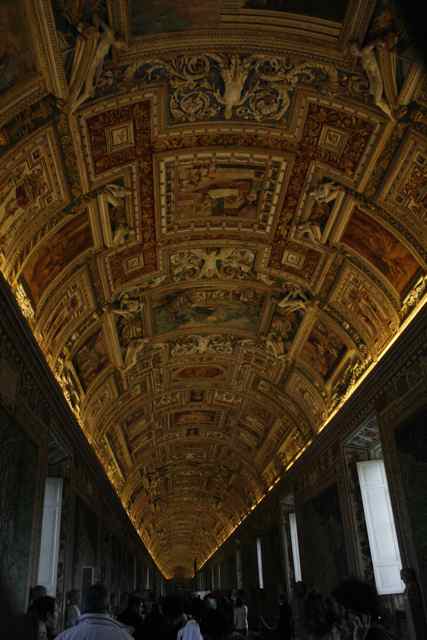
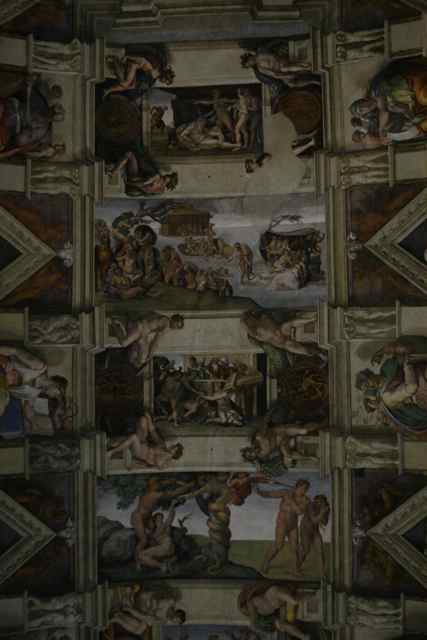
The issue with the latter, is that from the beginning we saw signs pointing to the Sistine Chapel, which we followed, turning this way and that, passing collection after collection. All was extraordinary; the paintings were amazing, the architecture stunning, the marble heads endless, but this elusive Sistine Chapel just never materialized. I started to get a little snippy and jaded when I saw these teasing signs, but finally, after miles and miles of walking (and muttering) we came to the Sistine Chapel! It really was amazing, and we sat quietly on the side benches (thank goodness for those!) staring up at the vastness, then reading the guidebook, then staring some more. The details are infinite, and due to the height often indiscernible, but the guidebooks were of great help.


When we were in Florence I bought a book about Michaelangelo that gave some very interesting insight into his works, including “The Last Judgment” which is on the wall above the alter in the Sistine Chapel. Following its completion in 1541, Pope Paul III convoked the Council of Trent and one of their “reformations” was to hire another artist to add strategically-placed fig leaves, pants and drapings to many of the nudes. Fashion History 101: “Reformation Collection, 1541”.

By this point, we had reached our goal. Unfortunately we still had more galleries, walkways, rooms and artwork to pass. I had hit my culture-saturation level by this point, so my personal goal was to just “get out of the Vatican.”

You’d think by this point we’d be calling it a day, but no, we had more museums to see! We visited the Crypto Baldi Museum and the interesting thing here was that it was built over some discovered Roman ruins that you could see below. The collection was well-presented, but we had hoped to explore the ruins, but that was prohibited. By now I seriously had reached the culture flood plains and piles of potsherds weren’t renewing my energy so I was ready to call it a day.

From here we decided to wander and see what we could find for dinner. As we were walking down a main road the rain started to really pour down, so we ran down a side street, solely because it was draped in twinkling lights from one side to the other (it's the Tinkerbell theory). I actually started to run because of the rain and I ran passed a very old-looking round building and as I came into the open square I turned to look and saw that we were standing in front of the Pantheon! What an amazing find! We decided, despite the rain, to eat outside, facing the lit-up Pantheon, under an awning with gas heaters. It was beautiful and incredibly romantic. Unfortunately it remained pouring and halfway through dinner was I freezing, despite snuggling up to the gas heater and Ron. So we entered back out into the rain to catch our bus home.


For an added treat (and because I was a little whiny and begged Ron), we stopped off a few blocks from our hotel at Giuliani’s Café where we got one cannoli to share and I got a hot cocoa to go. Having visions of a Starbucks-like cup, I was delighted to receive a small plastic Dixie-like cup instead with a “lid” made of a napkin tied around it like a kerchief. It was adorable, albeit ineffectual. But the cocoa was tasty, even if lukewarm, by the time we got back to hotel, and the cannoli was definitely one of the best I’ve ever had in my life!