The zipper adventure

So I decided to make a day of walking-errands around Maadi. I examined the map, figured out my intended path, and headed off. It’s been getting progressively hotter here, and our temperatures have been reaching highs of 96-101 degrees. It may be “dry” heat, but it’s still heat and walking around helps you realize just how hot 100 degrees can feel.

I headed to the Community Services Association (CSA) first. They offer expats a small library, gym, coffee café, small gift shop, clothing consignment shop, and all types of activities, from outings, to cooking classes, to events for kids. My objective was to get the latest monthly magazine and pick up their event schedule for June. I perused the craft fair they had in the courtyard, but managed to not buy anything (knowing I’d have to carry it around with me all afternoon helped in my decision-making process).

From CSA, I walked along the road by the railroad tracks, past several small florist shops which tend to be small glass greenhouses. These are very common all over Maadi, but I’m waiting to buy plants until we move into Zamalek.

I crossed over the tracks and came up to the Maadi Grand Mall (MGM). Ron and I had come here once before to check it out. It’s an indoor mall, four or five levels, filled with some jewelry shops, book stores, toy stores, and electronics, but mostly with women’s shoes and clothing shops (some western wear but mostly typical Egyptian Islamic clothing – which, although it’s all-covering, is still colorful and shapely). My objective here was to find a tailor and get the zipper on my carry-on bag replaced. I had my Arabic sentence all ready to go, “Ayza suusta gideeda, min fadlak.” (I need a new zipper, please.) It was about 11:30am, and I’d say maybe half of the stores were open. Luckily a tailor in the basement was open and I walked in and said my well-practiced sentence. The tailor and his son (presumably) just stared at me. I repeated it, used the bag with a broken zipper as a prop, but something wasn’t going through. Luckily there was another customer in the shop and she helped and relayed to me that they could repair it for 7LE (~ $1.40) and it would be ready in an hour. I handed the bag over with a smile (universal language), and walked out. I’m getting a tad frustrated over this language thing.

Initially my plan was to drop the bag off and come get it several days later. I mean, nothing’s ever ready “in an hour” back home. I was going to walk on to the Maadi public library, then take a cab home. Now I had to come back here. So I decided to brave the heat, walk on to the library and skip the cab. I walked the 15-20 minutes to the library and stood in line at the guard shack outside the gates of the library. I found I had to pay 2LE to get in; fine. I walked in and spoke with a woman at the desk to find out how I get a library card. Again, some language issues, but I managed to learn that it costs 55LE (~ $11) per year to join and I have to bring in a photo for my ID and my passport. Bummer. With my free time I’m going through books like crazy (I’m on my eleventh one now, and realize I didn’t bring enough with me to hold out until our final shipment arrives). I was allowed to look around the library, but not take any books out, so I checked out the artwork on the walls, saw the conference rooms, and at one point had the guard chase after me when I (unintentionally) started to wander up the stairs to the roof. I left without books, but at least knowledge of how to get books. (The embassy actually has a nice collection in their lending library, so I did make it there a few days later to stock up.)

I meandered back to MGM, having to play several rounds of Frogger along the way. I realized that I have not yet managed to embrace the Egyptian way of crossing these streets. My method involves a lot of looking, gauging, hesitating, false-starting and then eventually dashing. Their method is to look and walk. No gauging, no running, just walk calmly in front of the on-coming bus. I may be too type-A for that.

I got back to the mall around 12:15pm and wandered around a bit to pass the time. By now, the remaining half to two-thirds of the shops were finally opening. Buckets were out, sudsy water was being scrubbed over the shop floors, merchandise was being put on display, window dressings were being changed. It was noon, Cairo was waking up.

I retrieved my bag, with newly fixed zipper, paid him, thanked him and began the walk home. I certainly could have taken a cab (it would have been less than $2), but I decided to push through and walk the ~20 minutes home. In hindsight I should have taken a cab – I was feeling the heat by now and exhaustion was coming on, but then again, had I taken a cab I wouldn’t have passed the little lawn-chair man. As I was walking by the Maadi House (it’s an expat “club” with a restaurant, pool, kids’ playground, etc. and we sometimes go there on Thursday nights for dinner), I must have mopped my brow as someone suddenly said, “Very hot.” I hadn’t really noticed anyone before this, but when he spoke I turned and saw this tiny man wearing a white turban and a filthy tan gallibaya, perched on a white plastic lawn chair, smiling with his remaining three teeth that were the same color as his skin. He must have been about 112 years old. I smiled at him and nodded, and he threw his head back and laughed and laughed with glee. I’m not sure why. But I couldn’t help but smile for the rest of the walk home.

Interactions like this aren’t overly common. I think mostly I get a lot of stares, but I’m good at ignoring those. However, I had one interaction in the cafeteria at the embassy the other day. It was mid-afternoon and I was passing time waiting for the shuttle to take me back home, so I bought a bottle of water with the intention of sitting and reading. The cashier was counting out his money drawer when I brought the bottle to him. I held it up and said, “Mumkin?” (Can I?) He smiled and said yes and rang it up. It came up 2LE and he said something to me in Arabic. I was fumbling through my bills (still have to get used to them) so I looked up, saw the price, and said, “Itneen gineh?” (Two pounds?) He repeated his sentence with a smile. I still wasn’t getting it. Finally he leaned over to me and said, “You are very beautiful.” I laughed, said I thought he was telling me “itneen gineh,” paid and went and sat down. I found the whole thing rather funny; I was so focused on trying to hear what he said, but mistakenly pre-assuming what it was, that my brain couldn’t comprehend his “Inti (something)” comment. I told Ron later; he didn’t laugh. He was quiet for a moment, then pointed out that in certain areas here if he made the same comment to an Egyptian woman he’d be attacked. I couldn’t deny it. There is a huge double-standard here. My thought is that as long as no one touches me or makes me feel uncomfortable, then I can just ignore the comments. I have heard stories here of random comments going beyond that, to actual grabbing and touching. I do find it mystifying that in this culture Egyptian men would never dream of grabbing an Egyptian woman’s behind, but there is a presumption among some men that Western women are “virgins or vamps” (only not the former). This is certainly not exclusive to Egypt, or even the non-Western world. So, depending on my mood, Ron’s mood, and the nature of the comment, we will respond (or ignore) accordingly. And, as always, I will continue to improve on my Arabic.

CORRECTION: After reading this entry, Ron told me I was wrong… the Egyptian men who would grab at someone would not distinguish between a Western woman and an Egyptian one – they’re equal-opportunity grabbers. So I stand corrected (but sadly not relieved). Also, the men who would assault someone are typically younger and it becomes almost a game to see what they can get “away” with. As I said, I’ve never experienced anything improper, nor have I felt uncomfortable anywhere (although I was definitely hyper-aware on the subway – as I am in any city). I told Ron that I would continue to be aware of my surroundings and will watch out for any seemingly opportunistic young men – Ron told me to just watch out for everyone. I wonder how long it will be before he brings home a burlap bag for me to wear?

Must remember Dramamine

Last weekend the embassy’s language lab sponsored a shopping trip to Kerdasa, a city on the other side of the pyramids. This was intended to make, or allow, us to try using our burgeoning Arabic. Ron declined, but I opted to go.

There were about 14 of us in two shuttle vans. I was chatting with the women in my van and found that most had been in foreign service for 15-20+ years. I was the newbie. They all expressed surprise that this was our first post and then reminisced about their first posts (not all fun, happy stories – things were very different in the 70s for spouses – one said she was required to get her husband’s signature/permission in order to work, buy a plane ticket, etc., and this was in Asia, not the Middle East; luckily the foreign service is now much more family-friendly).

The vans trundled through the city streets and I was in look-out mode, watching everything around us, however I had forgotten that I tend to get carsick in backseats. Half way there, I was curled up, covered in cold sweats, practicing my Lamaze breathing, and wondering whether I could get my shopping bag out of my backpack before puking on my camera. I was surrounded by “mothers” so everyone was very kind to me and luckily we arrived without any alternative need for my shopping bag. I fell out of the van, very happy to be back on dusty but stable ground.


Kerdasa is a very small town but is apparently known for its gallibayas. In the main street, there were shops upon shops of gallibayas in a huge assortment of colors, fabrics, embellishments and trimmings. One of the language teachers had reviewed with us typical shopping phrases, colors, numbers, etc. and we had a 4-page hand-out for reference. They split us into groups and we wandered off. We were all a bit hesitant to try our Arabic (and as usual, all the shopkeepers spoke English), but we did make attempts and when one of us wanted to make a purchase, the teachers “helped” us bargain – which really meant we stood back and let them bargain for us. Bargaining is very big here, although not in large supermarkets and stores. They say that typically if you get ¼ off the asking price, it’s a good deal for you.

I was dazzled initially by all the frippery around – it was like being in a Bollywood costume set (though I do realize those would typical be full of Indian dresses), but I did get into the shopping mode and bought a shawl that was hand-embroidered by Bedouins (Ron added, Bedouin children), and a deep blue gallibaya shirt. The prices were great and the choices were huge. Some of the gallibayas we saw were so elegant you could wear them to a formal event. Others were light cotton, still extremely colorful, but less adorned and sexy and more typical of what women would wear around the house (the Egyptian housecoat).

I was able to use my color-knowledge, but my numbers are weak so I have to practice them. There are so many steps or layers to this language-learning thing. First, it’s learning a new alphabet and being able to recognize the letters, next it’s memorizing reams of vocabulary, then it’s being able to correctly pronounce words (a slip of the tongue and you’ve asked where the pigeon is, not the bathroom), and finally (which is what I realized at Kerdasa) it’s being able to recognize words when they’re said back to you – active listening. My poor little brain was emitting puffs of smoke by the end of it all.

As we were getting settled back in the vans, grabbing water from the children selling bottles, we heard a man’s voice over a loudspeaker. I didn’t think too much of it as I’m getting used to hearing the call-to-prayer several times a day, and since I don’t (yet) understand what they’re saying I wasn’t listening closely. Our teacher told us that Kerdasa was such a small town, with a very close community, that they didn’t use newspapers, but instead relied on word-of-mouth, and when something of timeliness needed to be reported, they used the loudspeaker. The man was apparently announcing the passing of a local townswoman and telling folk when the viewing at the mosque would be later that night. So here was this old-fashioned small town using modern loudspeakers to keep everyone informed. Amazing.

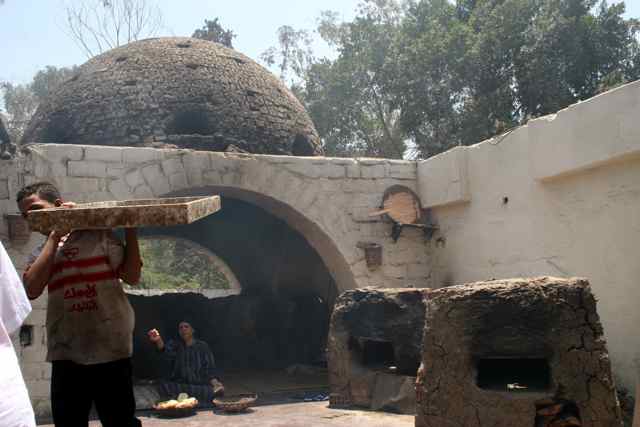
Carting away our happy purchases, we drove on and ate lunch at a great outdoor restaurant called Andrea’s, where they cook the bread in outdoor ovens and flowering trees arch over the walkways. I managed to feel carsick on the way home too, so I was less-than-chatty and practically rolled out of the van so delighted to be let out at our front door. Being “chauffeured” around certainly has its benefits, but there are times I do miss being a driver. So now, in addition to hand-cleaner, sunglasses, SPF, a cell phone and money, I will also always carry Dramamine.

The Hanging Church & resting spot of Joseph & Mary

Friday, after our weekly visit to the commissary (for Morningstar fake-meat crumbles (can we say, jump for joy, do a little gig, happy dance?), veggies, soy milk, cereal, etc.), Ron and I decided to explore a section of Cairo called “Old Cairo” or “Coptic Cairo.” Despite his whinings to my constant urgings for us to “do something,” his typical response being, “We’re here for three years. There’s no reason to cram it all in the first two months,” he does placate me often. We decided to explore this section because it was easily accessible by metro, and was something we could see parts of in just a few hours, instead of all day.

In my continuing attempts to use some Arabic, Ron sent me ahead to buy our four subway tickets. I know that everyone here speaks English, but they all seem to get a kick out of my Arabic murmles and I appreciate their smiles of encouragement. I bought the tickets and we were off. This was one of the first days that I really noticed the heat. And from what I’ve heard, this is nothing compared to July and August, when all the “smart” people leave the country. But this was a 90-degree-type day, where you feel the sweat slowly trickle down your back when you stand still and you seek out the shady side of the street to walk on.

If you haven’t gleamed by now, I find Cairo to be an amazing mix of contrariness. A perfect example is getting off the subway at Mar Giris, where there were high-rise apartment buildings on one side, buffeted by piles of rubble and trash, and the other side held “El Muallaqa,” or the Hanging Church, dating from the 7th century (though it’s suspected that it was built on a previous church from the 3rd or 4th century). According to www.sacred-destinations.com:

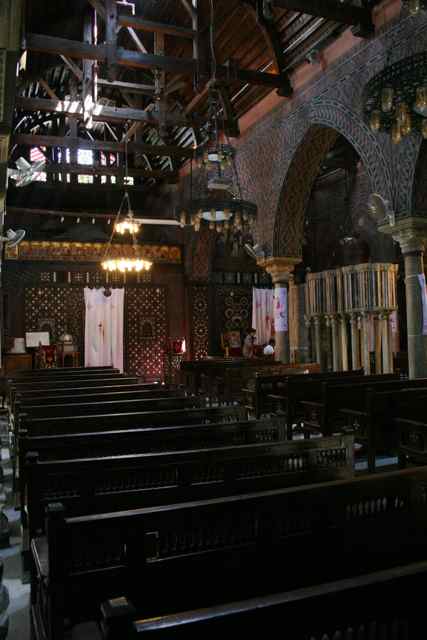
"Known in Arabic as al-Muallaqah ("The Suspended"), the Hanging Church is the most famous Coptic church in Cairo. The church is dedicated to the Virgin Mary and is thus also known as Sitt Mariam or St. Mary's Church. The Hanging Church was built in the 7th century…. By the 11th century, the Hanging Church became the official residence of the Coptic patriarchs of Alexandria…. The main furnishings - the pulpit and screens - date from the 13th century….The 11th-century white marble pulpit surmounts 13 graceful pillars, representing Jesus and the 12 disciples. As customary in Coptic churches, one of the pillars is black (basalt), representing Judas, and another is grey, for doubting Thomas…. [The church] derives its name from its location on top of the southern tower gate of the old Babylon fortress with its nave suspended above the passage…. However, though there are many objects from the church in the Coptic Museum, inside the church are collections of over one hundred icons of which the oldest dates from the 8th century." They have constructed some glass-covered openings in the floor so visitors can see far below to how the church appears to be suspended over air (it seems to have been built on the remains of old Roman walls).

The word “Coptic” is currently used to describe Egyptian Christians. Statistics vary depending on the source, but somewhere between 6-15% of Egypt’s population are Copts. Wikipedia succinctly states: “According to ancient tradition, Christianity was introduced to the Egyptians by Saint Mark in Alexandria, shortly after the ascension of Christ and during the reign of the Roman emperor Nero. The legacy that Saint Mark left in Egypt was a considerable Christian community in Alexandria. From Alexandria, Christianity spread throughout Egypt within half a century of Saint Mark's arrival in Alexandria, as is clear from a fragment of the Gospel of John, written in Coptic, which was found in Upper Egypt and can be dated to the first half of the second century…. In the second century, Christianity began to spread to the rural areas, and scriptures were translated into the local language, today known as the Coptic language (which was called the Egyptian language at the time). By the beginning of the 3rd century A.D., Christians constituted the majority of Egypt’s population, and the Church of Alexandria was recognized as one of Christendom's four Apostolic Sees, second in honor only to the Church of Rome. The Church of Alexandria is therefore the oldest church in Africa.

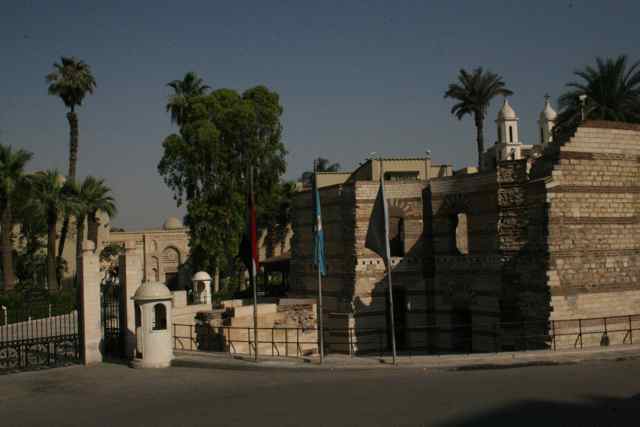
After the church, we ventured into the Coptic Museum located next door (though I had to leave my camera outside). Founded in 1910, they positioned it within the walls of the Babylon Fort from the Roman times, like the Hanging Church. Some of these original Roman walls can still be seen today. The Coptic Museum was the complete opposite of the Egyptian Museum downtown, as it was clean, and well-labeled, and well-displayed, in the most beautiful building. The architecture of the museum alone was worth studying, with intricate wooden-carved ceilings, detailed mashrabiya window shutters (carved wood latticework), and an inner open courtyard filled with flowers and plants. The museum displayed artifacts dating back to the 3rd and 4th centuries. They had wonderful exhibits of clothing and fabrics, books and manuscripts, pottery, ivory and even original fresco paintings from Egyptian monasteries from the 6th and 7th centuries.

I found myself staring at a piece of cloth that had delicate embroidered flowers and vines, knowing that 1,400 years ago someone had sat and sewn that, having no idea, or probably intention, that it would survive for over 15 centuries for me to be examining it under glass on a hot Friday afternoon in Cairo in 2008. I felt the same way looking at the books and writings. Some were evidence of receipts for traded goods, even written on old pieces of broken pottery (10 bales of wheat for 4 camels, 5 goats and a fig tree for one slightly-gimpy daughter, etc.), but the religious texts were hand-written in florid script, with painted details and gilded letters. As self-admitted biblio-geeks, Ron and I thoroughly enjoyed the manuscript exhibits. (As further evidence of our biblio-geeked-ness, in the seven weeks we’ve been in Cairo, we have located and visited more than six new bookstores. It’s in my blood; I’ve learned to not fight it. Much like the naturally curly hair. Just accept your fate, live with the curls, relinquish the dream of Marsha-Brady-straight-hair, walk calmly into every bookstore you can find, and save your energy for other battles.)

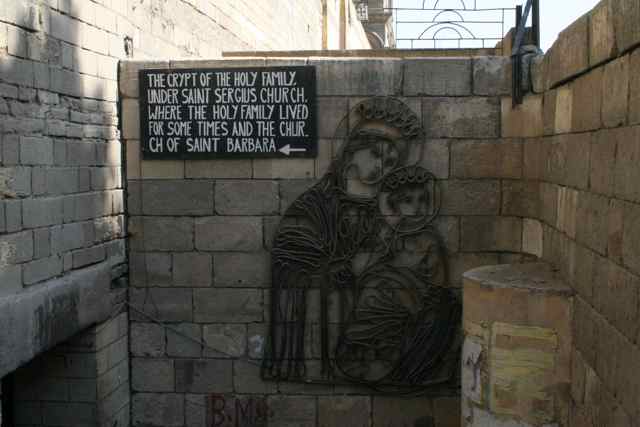
The museum closed at 4:30pm (as most things do when their posted hours are 5:00pm). Ron took me down the street to an alleyway of shops selling everything from rugs to jewelry to pottery to papyrus to books to … well, everything. In addition, the Church of Saints Sergius and Bacchus (4th century) is located along here and considered to be the oldest of Cairo's Christian churches. It is said to have been built on the spot where Joseph, Mary and baby Jesus rested at the end of their journey into Egypt (though I don’t think they perused the same wooden pig carving I was eyeing).

We were getting the Cairo-dust-mouth feeling by this point so we hopped back on the metro and took it down to Sadat Station. Playing a bit of Frogger, we managed to cross over the traffic torrent and ate dinner at Felfela, a wonderful little restaurant with stone floors and walls, wooden-beamed ceilings covered in (fake) vines and grapes, and tables made out of thick slabs of petrified wood. We had fresh mango juice, hummus, tahini, and wonderful falafel! The only negative for me was the caged birds on display, but Ron requested a table far from them and allowed me to sit with my back to them.

[The issue of trying to avoid or ignore the animal abuse around Cairo is something I’m going to have to figure out how to deal with. It is constant, with emaciated stray dogs and cats rummaging through garbage, tired old donkey carts, horse carriages in the sun, camel rides, terrified cows and sheep being transported in pick-ups through the city – I can’t really avoid it. The suffering isn’t specific to animals, either. Children beg for money, rummage through garbage with the strays, and poverty is pervasive. Ron and I saw two little girls climbing the stairs at the subway together, covered in dried dirt, with matted hair and filthy dresses, and they couldn’t have been older than three and five. Their mother followed after them carrying two babies like sacks of potatoes. I don’t have an answer. It’s something I think about a lot and when I come up with a solution to diminish the world’s suffering, I will be sure to share it.]

So as to not end on a down note, I’ll close with our decision to ride the metro home instead of taking a taxi. I believe I’ve mentioned before that it was a hot day, and the subway cars do not have air-conditioning, though they do use small fans to gently distribute the steam and odors. Combine all these factors and I found myself in a crowded car, wedged up against Ron (my choice), and several others (not my choice), quite possibly being the only female in the car (though I may have spotted another at the far end), with armpits as far as the eye could see. I think the air started to take on a semi-solid state. By the time we peeled ourselves out of the car at our stop, my head was feeling a wee bit faint and my eyes had started to tear.

So far, Ron and I have come up with two things NOT to do in Cairo: 1) ride the subway at rush-hour during a hot summer day (without a respirator), and 2) have the taxi drop you off BEFORE the bridge in Maadi, do it after the bridge, or you will have an extremely harrowing walk up and over the bridge, balancing on the curb, grasping the filthy guardrail to prevent you from leaning into the traffic whizzing by all the while trying not to get your hip clipped by a side mirror (this was a lesson that we only had to be taught once).

A (blue) birthday bucket

In celebration of my birthday, I decided to knock off two more mini-accomplishments on my comfort-zone-expansion list. Now, when I say mini, I mean, truly miniscule, but they say that it’s the small things that truly matter – and in essence, it’s the small things that make the big things happen. So, I gathered my wits, money and sunglasses and headed out to Road 9 on my quest for a birthday bucket. I first stopped off at Radio Shack (yes, we have “Radio Shack”) to see if the shipment of compressed air had come in. I need some to clean my camera lens and when we stopped in last week we were told a shipment was coming “tomorrow.” So I popped in and was told, again, that the shipment was coming “tomorrow.” I explained that we had been told this last week and asked if this was a popular item. They said yes, but said there was one can in the Dokki store and would I like to have them hold it for me. I declined and said I’d stop in here again. Now, I’m no retail whiz, but if you have an item such as the Nintendo Wii, or say compressed air, that you just cannot keep on the shelves, wouldn’t you try to get maybe TWO cans in a shipment? The other issue, which becomes the flip-side of a good thing, is that Egyptians are very friendly and accommodating, to a degree in which they almost never say no, even when the answer is, No. So you will rarely, if never, find anyone who cannot give you directions, even if they’re wrong; and apparently the missing item you want is always coming in the shipment “tomorrow.” I will continue in my dogged pursuit of a can of compressed air.

Shaking off my failed purchase, I wandered over to a store I had seen before but had not yet entered. Outside there was an assortment of plastic-goods, such as bins, baskets, and buckets. We needed a bucket. We had been “assigned” a bucket in our welcome kit; a nice, big, sturdy, black bucket that I had used in my first attempt at mopping our apartment – and in true Egyptian-irony, I filled it up and promptly noticed the small hole in the side; essentially reducing said bucket to a trash can. (I never really appreciated the potential complexities in mopping until this attempt. Despite my education and length-of-tooth it took me a ridiculous amount of time to figure out how to use the mop; however, never let it be said that I retreat from a challenge, so eventually I figured out how to wring the mop without touching the moppy bits.) I picked through the stack of buckets and chose a blue one and took my purchase inside, which was made of up two rooms, one filled with toys, and one with miscellaneous kitchen gadgets. So this must be the “Toys, plastics & kitchen ware” store – good to know.

Now, these outings of mine are not just a means to explore and spend money (our bucket cost $3), but also an attempt at using my slowly growing vocabulary. However, whenever I attempt to use it, I tend to get English back. It seems we all want to practice. But I will keep trying (see “challenge” comment above).

I took my birthday bucket home, rinsed off the dust, and proceeded to get ready to meet Ron downtown for our birthday dinner out. He had chosen a restaurant others had recommended called, Sequoia. It’s located at the very tip of Zamalek (island in the Nile, which actually comes to a point). My second mini-accomplishment was going to be taking a taxi by myself. I had chosen to wear a new dress and strappy sandals, however I suddenly realized that I had paid for my birthday bucket with the one 20 LE note and only had 50s and 1s left. The issue here is that the taxi to downtown is about 25-30 LE (a little more at night), and taxi drivers NEVER have change (odd, isn’t it?). So, I knew I had to walk to the store, buy something and get change, before grabbing a cab. The secondary issue was that I didn’t want to walk to the store in my dress and strappy sandals (too many stares, too many craggy sidewalks, too dusty). So I changed outfits, chose less-cute but more-practical shoes, walked to the store and got change and grabbed a taxi. In my continued attempt at Arabic, when he said to me, “Where are you going?” I answered, “West ilbalad. Fondo Shebard.” He replied, “Hotel Shebard?” Slightly defeated, I said, “Yes.” (Note: It’s actually the Hotel Shepheard, but Arabic doesn’t have p’s, so they become b’s – Pepsi is Bibsi.) The ride in was uneventful, aside from his being a “weaver” who continually swayed back and forth across the lanes. I just swayed along with him and enjoyed the view, pleased in my mini-accomplishments for the day.

Ron met me at the Hotel and we grabbed another cab to Sequoia. The dinner was fabulous! We sat outside, watching the sun set over the buildings across the Nile, sitting on white-linen covered cushioned chairs, with a breeze and people smoking shisha all around (the water pipes are very popular, with men and women both, and they smell quite nice – with the tobacco often being fruity or flowery – it has been discouraged for us, as expats, though, due to the high rate of tuberculosis – discouragement achieved). We had some of the best mezza we’ve had in Egypt so far – hummus, tahini, tomato salad, fettoush – and in hind-sight we agreed that next time we’ll just make a meal of those and drinks. As the sun set, lamps and lanterns were lit, making it a wonderfully romantic setting. This will definitely be a favorite of ours. All in all, a very successful “Egyptian” birthday.

Napoleon stood here, a while ago (as did Cleopatra)

For my birthday this year I told Ron that I’d like to do something “Egyptian.” Apparently he first considered a few games of Frogger, followed by some watermelon truck races around the propane donkeys, but luckily he opted instead for a night out in the desert, just us, two friends, a guy named Sphinx-y and the last remaining wonder of the ancient world – the pyramids of Giza.

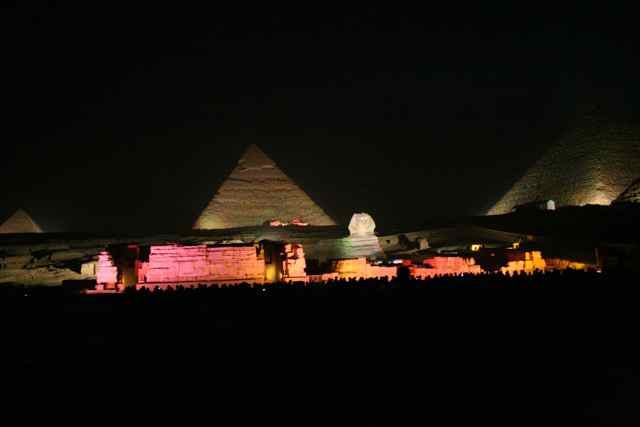
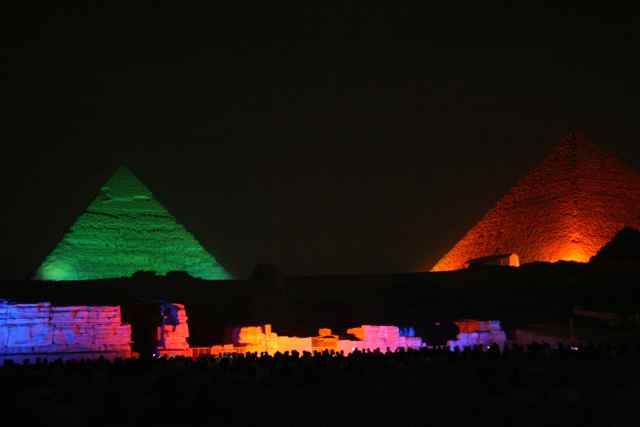
Ron arranged a shuttle and we met two friends in downtown for dinner first, then headed out of Cairo to Giza, which is only about 40 minutes away, to the nightly “Sound & Light” show. It was a little campy at times, replete with a Pharonic marching band playing the bagpipes (not a sentence I ever imagined writing), but you couldn’t deny the amazing setting.

The town of Giza nudges right up next to the pyramids’ boundary. But if you faced the pyramids, you could ignore the KFC and Pizza Hut signs, neon offers of “genuine” pyramid souvenirs, cafes, restaurants, and shops, shops, shops. We weren’t able to wander up to and through the pyramids, as you can only do that in the daytime, so we will return to do that another time. But watching the sun set behind the pyramids as the desert breeze blew, we drank our hibiscus juice and I had my perfect Egyptian birthday (with bagpipes).

I have been remiss in posting photos, so here are several from the show.

Basic stats: They were constructed ~2560 B.C.; “pyramid of Khufu” is the oldest and largest of the three, can be seen from the moon and was the tallest man-made structure for over 3,800 years; it’s estimated that construction took 2,300,000 blocks of stone, weighing an average of 2.5 tons each; the dimensions of the sides of the pyramids are exactly the same length to an accuracy of 0.1 +/- inch; the sides are oriented to the four cardinal points of the compass; the length of each side at the base is 755’; the height was originally 481’, currently 451’.