Spices, cabbage and lingerie

Following our explorations at Ibn Tulun Mosque, we ventured over to the Gayer-Anderson Museum, which is conveniently located right next door. The museum is actually two houses, one built in 1540 and one in 1631, that were restored and connected with a bridge-room in the 1930s by an Englishman, Major Gayer-Anderson.

The rooms are beautifully decorated in Gayer-Anderson’s vast artwork, furniture and décor collections, and give an idea how the well-to-do Cairene might have lived during the 1930s.
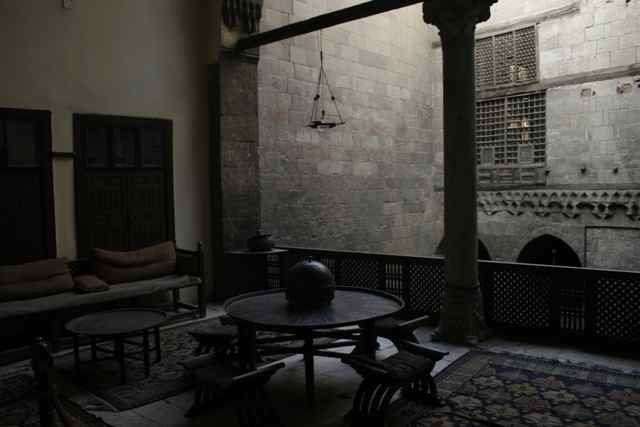
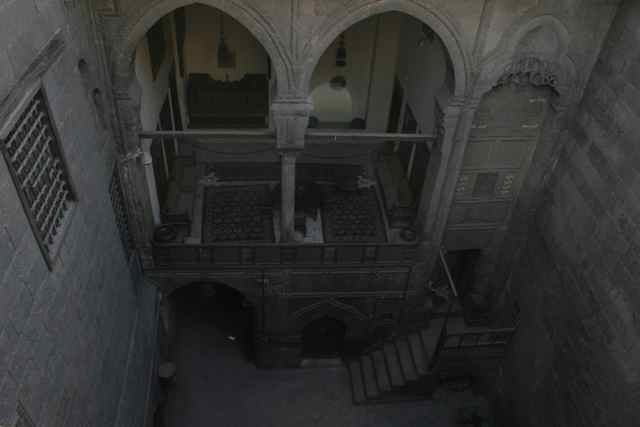

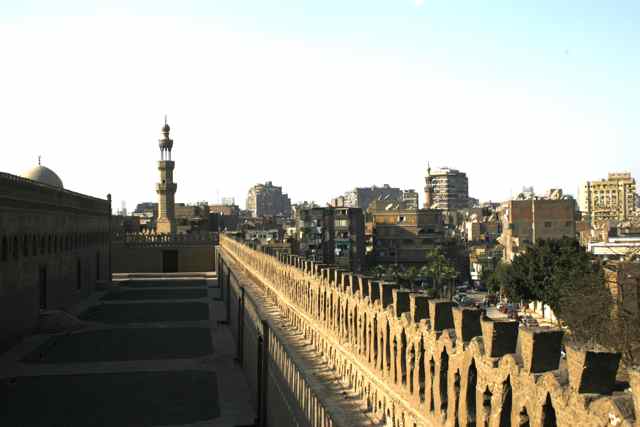
The roof of the connected houses is rimmed with mashrabiya screens, which, as you can see, were designed around a view of the Citadel. There were also scenes from James Bond’s “The Spy Who Loved Me” filmed on this roof, and in one of the interior rooms, so now we have to rent the movie again and watch more closely this time.


Following our force-guided tour (you “have” to have a guide, if merely to turn on the lights in the rooms as you walk through – having done it now twice, I can tell you that the same things/stories/jokes are told during each “tour” – slightly tedious, but compulsory), Haitham and I decided to do some walking. Now, when I say “some” walking, I need to preface this and add that Haitham’s idea of a nice walk is to go from Ibn Tulun Mosque in Islamic Cairo, to home. So that’s what we did. All in all, I think it was at least five miles, but it felt longer.

But this was the beginning of my foray into a whole new side of Cairo that, prior to Haitham’s guidance and accompaniment, I would not have ventured into. It’s not that it’s unsafe, but it’s inner inner Cairo, and I don’t recall seeing many (any?) other non-Egyptian-looking folk, or blondes from Ohio. Plus, English was not as readily available as in touristy areas, so I had to rely 100% on Haitham asking for directions, several times as it’s always best to double and triple-check.

It was really fascinating walking through these streets, through people’s daily lives (of course, no camera this day… but I definitely got photos on our next outing). I did have a few moments where I felt like the human sore thumb, but I have perfected the act of pretending that people aren’t staring at me, or on particularly egocentric days pretending they’re mistaking me for a movie star. Either way, I just keep walking.

We had decided to try to find a market to buy some spices and maybe some veg. I really wanted to take advantage of Haitham’s language skills to replenish my spices and get some new ones. So we had been directed to a local market that was around behind the As-Sayyida Zeinab Mosque. This is an interesting mosque, in that it’s built for a woman, Sayyida Zeinab, who was the granddaughter of the Prophet Mohammed and is also the patron saint of Cairo. Ironically, at least I thought so, women are only allowed in the mosque through a side entrance and no non-Muslims are allowed in.

The market was indeed behind the mosque, and there was no question this was a local market. Foreigners were definitely foreign. But again, I pretended I come there all the time, and followed Haitham closely at his heels. We walked past stands stacked with fragrant oranges, then walked through the grapes and apples, onto the cutlery and pots and pans stalls, then past the hanging unidentifiable carcasses with furry tails stall (I diligently checked out the pink plastic salt and pepper shakers opposite these as we passed), finally to come to the spices (we merely had to follow our nose).

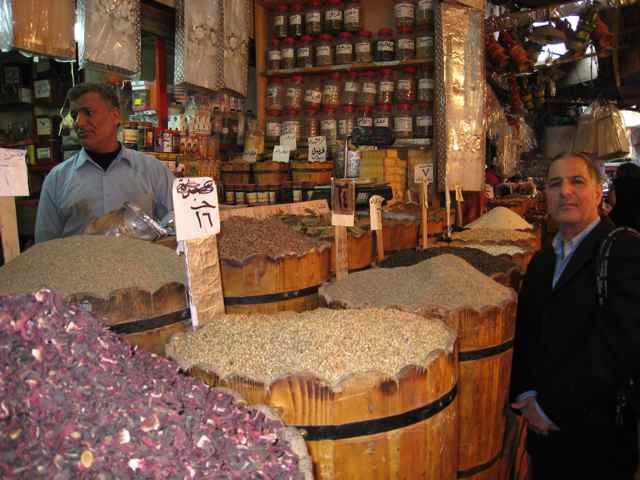
I love these! The mounds of colorful, fragrant, inviting spices, stacked up in their individual barrels, waiting to be scooped up and weighed. We were very successful and replenished my cumin and curry supplies, then added cardamom and turmeric and tried some Yen-Soon (anise) tea. (And Haitham was kind enough to let me document our success using his camera and himself.)
From here we wandered back and passed some gargantuan cabbages. Haitham was interested in getting one, ideally smaller than a car tire, so we picked through a stack, found an acceptable one and then looked around for the stall owner. We were directed to an elderly woman perched in a plastic deck chair. Haitham carried the cabbage to her, and I stood back, watching the whole interaction: Haitham in suit jacket, surrounded by Roald Dahl cabbages, standing under a sea of slinky lingerie hanging from hangers over their heads (we had obviously found the one-stop shop for those buying cabbages and negligees). The woman never took her eyes off Haitham, even as he handed her the cabbage. She reached out and gently patted the cabbage, obviously assessing Haitham more so than the vegetable. Making her decision she told him the price (obviously not necessarily by weight, but rather weighty stare). We paid and exited the market.

We had decided to walk home from here, so we got our bearings and headed to Tahrir Square or downtown, then home. As we walked through the crowded streets, full of shops, people, cars, busses, taxis, and more people, we passed one of the women selling the Baladi bread on the sidewalk. Haitham bought us three pieces for dinner (1 EGP each = $.18). It was my first “street food” purchase and quite a thrill. Ron’s comment later was, “Did you make sure to get the ones that had fallen on the ground?” We assured him we got the ones with extra dust and schmutz.
Islamic Cairo, not for the faint of heart or flat-footed

January brought us our first houseguest! Haitham, Ron’s friend from the Met in New York, came for a few weeks, and it is for him and him alone that I saved Islamic Cairo (other than the Citadel). The reason for this is simple, there is no one more knowledgeable or better versed in Islamic art than Haitham (which is good since he teaches it at three universities in NYC).

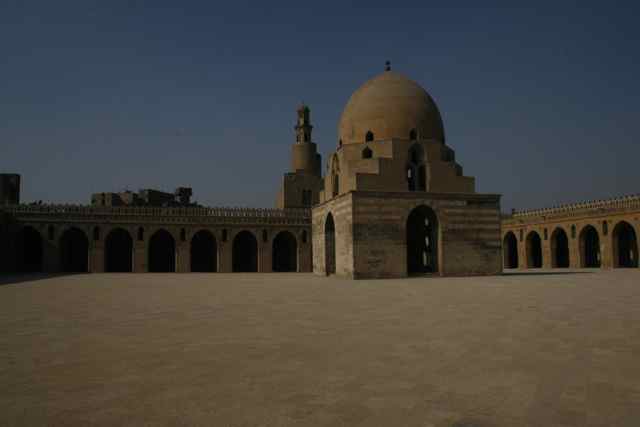
So, after resting up from his travels, we ventured out for our first adventure starting at Ibn Tulun Mosque. Actually it started earlier than that as it took us three attempts to find a taxi driver who knew where it was. The irony is that the mosque and accompanying Gayer-Anderson Museum are in the top five tourist sites for Cairo. And the mosque itself covers 6.5 acres of land in central Cairo, so it’s no hidden gem. It’s a gargantuan gem.

The Mosque of Ibn Tulun is the third largest mosque in the world and is the largest and oldest mosque in Cairo (completed 879 AD) boasting its original structure. Ahmad ibn Tulun himself was born in Baghdad, the son of a Turkish slave. He rose to become the governor of Egypt in 870 AD and ruled through 905 AD. There are many legends surrounding the location of this mosque, including it being the landing spot for Noah’s Ark, or the location where God spoke with Moses and Moses confronted Pharaoh’s magicians (I’m not familiar with that one…), or that close by was where Abraham was willing to sacrifice his son. Suffice it to say, there is great religious significance to this locale.


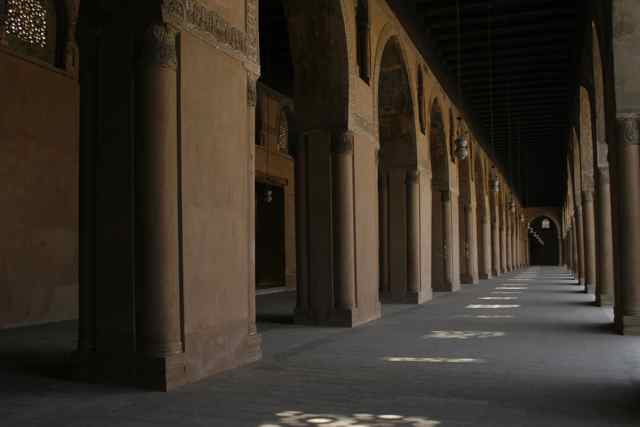
The mosque is designed with a large open inner courtyard surrounded by covered halls on four sides, with the deepest hall on the qibla side, or side indicating the direction of Mecca. Also on this side is the mihrab (niche in the wall to indicate the qibla wall) and minbar (platform or stairs from which the Imam gives his sermons or lectures). The domed ablution fountain in the middle of the courtyard is not from the 879 plans. The original ablution fountain was apparently changed to this present location at the end of the 13th century (and currently remains a waterless, albeit impressive, fount).

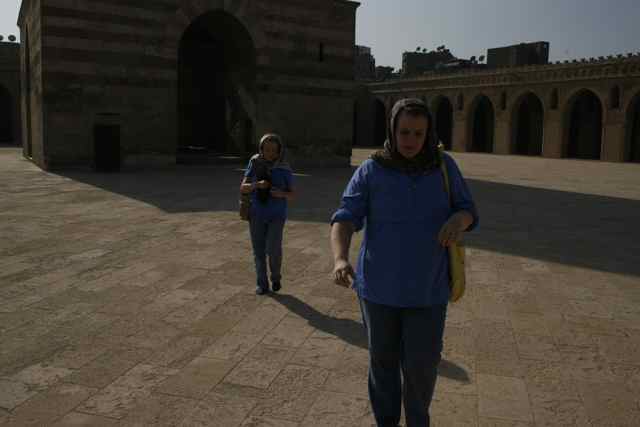
Haitham and I, after dutifully removing our shoes (I’m getting better at remembering to wear heavy non-white socks, as most of these mosques have concrete or dirt floors), I donned a headscarf to be respectful (though I hear it’s not as expected of Westerners), began to wander and explore. We carried an Islamic Cairo guidebook and read through the descriptions, which included indicating that three of the 128 plaster stucco windows were original. Following the book’s instructions, we counted off from one corner to find these windows, however by the time we got to the third one we were thoroughly confused and completely uncertain as to whether we had actually found the first two. So much for two brains being better than one.

The 13 arches on each side surrounding the courtyard are pointed at the top; a design style that didn’t appear in Europe for another 200 years. The stucco designs decorating the inside of the arches are stunning in their intricacy and variations. Running along the top of the wall, under the ceiling is a band of sycamore wood stretching 1.2 miles around the mosque, inscribed with the beginning of the Qur’an. It’s said that some of these boards were salvaged from Noah’s Ark.


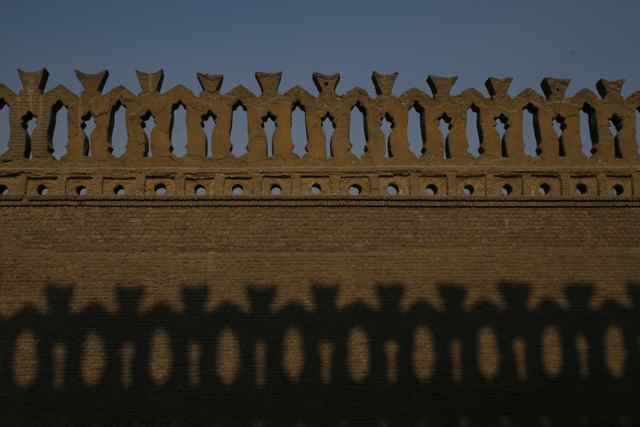
There is an outside wall, separating the mosque from the secular world or shops and apartments that press in on all sides. It’s topped with crenellations that give the impression of paper dolls linking arms. One guidebook states that while most likely unintentional, it gives a sign of solidarity, as well as a distinctive cut-out in the skyline.


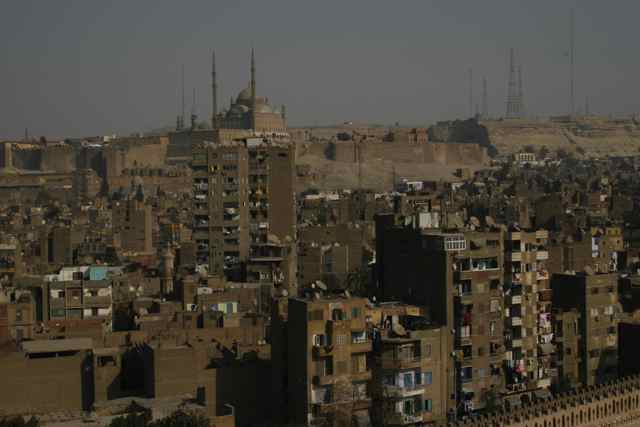
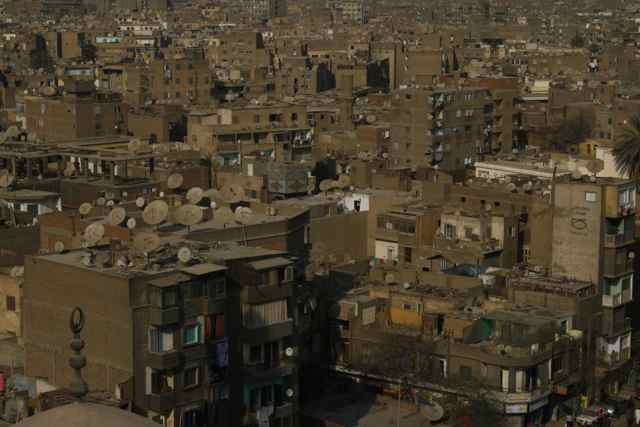
The minaret on this mosque is unique in its spiral design, however it’s uncertain what is still original on it. After paying the requisite bakshish, primary to get rid of the insistent guide, we clambered up the minaret. The top of the base rests on the roof of the halls surrounding the courtyard, so you’re able to walk around the top of the mosque. We continued up to the top of the minaret which, on a clear day, affords an amazing 365 degree view of Cairo, from the Citadel and Moqattam Hills, to down town and beyond. (No, Cairo is not "beautiful" but there is an awe-inspiring quality that cannot be denied.)


The mosque has a significant history of restorations and other-uses, including being used as a wool factory, hospice and caravanserai, or hotel of sorts for North African pilgrims heading to Mecca. The first recorded restoration was in 1177, then in 1296 and most recently in 2004.

During this trip I managed to bring a camera with a dead battery, so I didn’t get any photos. However, a few weeks later, Ron and I took Mom, who was visiting us, back and this time I made sure to bring a working camera (enabling documentation of the matchy-matchy mother-daughter look – which was unintentional, I assure you; Ron in his "rented" shoe covers; and Mom practicing for her upcoming role in "Aladdin.").


From here, my adventures with Haitham in Islamic Cairo had merely begun, so stay tuned!

Italy - Day Ten (sun in Florence)

Okay, this was our last full in Italy. We could either hop the train to Rome early and spend it there, or spend it mostly in Florence and take a later train to Rome (we were staying our last night in Rome, as we were flying out of there). There was still so much to see in Florence, that we decided to stay longer here, take a later train, and hopefully catch the Christmas tree finally lit at the Vatican.


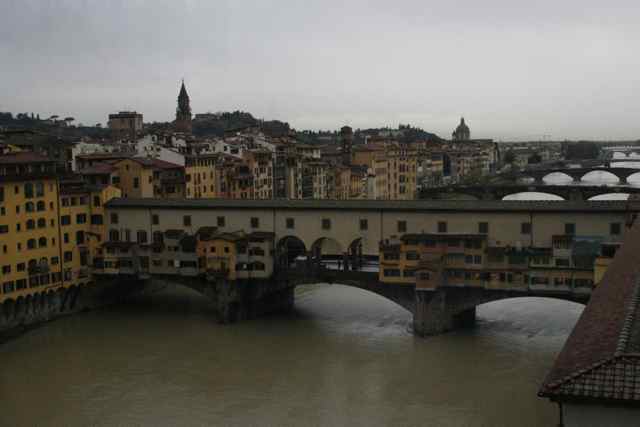
The day was beautiful! Full sun, no rain, gorgeous city. We checked out of our room and stashed our luggage with the concierge before heading out. We walked down the river to Ponte Vecchio, a medieval bridge spanning the Arno River with shops all along it. We passed a line of parked motorbikes that seemed to stretch for blocks (between those and the Smart cars, which are all over Rome too, it’s obvious that Italians have fully embraced economical vehicles).

We came to the Basilica of Santa Maria del Santo Spirito, which was rebuilt in the 1400s following a fire. It’s Gothic in design, but honestly since we were prohibited from taking any pictures inside I don’t recall a lot. There were a lot of paintings, and according to the guidebooks they apparently included a Lippi.

We headed toward the Galleria dell’Accademia, but when we got there, we weren’t sure where to enter. We wandered up to the university, located next to it, and asked someone where it was. We were unceremoniously told, “Left! Left!” and shooed out. I will say here that by this point, considering the number of a) snooty, or b) unhelpful, or c) snooty and unhelpful people we had run into in Florence, we were neither surprised or offended by her response. Initially though, we were surprised to find this so common in Florence, as people in Rome had been completely opposite and really pleasant. Maybe it’s the Gothic influence?

So we managed to find the not-so-obvious entrance, and bought our tickets. The Galleria dell’Accademia is the first art school in Europe, started in 1563, to teach exclusively painting, drawing and sculpture. In 1784, it opened its art collection for students and visitors to study and includes Michaelangelo’s “David,” works by Lippi (ahh, Lippi), Botticelli, and the original plaster for Giambologna's “Rape of the Sabine Women” (considering it was carved from a single block of marble I can see how it was considered to be his masterpiece).

In addition to “David,” there are also four unfinished marble sculptures of Michaelangelo’s on display that I really found fascinating. While “David” is stunning and beautiful, these other pieces, “Four Prisoners,” intended for Pope Julius II’s tomb, appear to be walking out of enormous marble blocks, with just their torsos and arms gaining shape.

We also saw some amazing Russian Christian icons, musical instruments, and yes, more “Annunciation” and “Adoration” depictions, just in case we were feeling in need of a re-fill. Overall the Galleria was a really nice museum, with nice displays, interesting and different pieces, and not too overwhelming.

We made it back to the hotel, grabbed our bags, asked the concierge what bus we should take back to the train station, but she appeared to only speak Russian, so we just wandered outside until we came upon a sign. Ron had previously seen that bus tickets could be purchased from meters that also offered parking passes, so we attempted to use one. It took a few tries, and a lost Euro or two, but we finally managed to get it to spit out two tickets. When a bus came, we hopped on for the quick ride to the station, however, as seemed to be our luck in Florence, this bus took us on an hour-tour of the other side of Florence, up into the hills, beautiful views, but as far from the station as could be. (The primary issue here was that we failed to purchase a bus map at the station when we arrived, plus no one we ever asked was helpful or knowledgeable about the busses, and therefore we will not fail to get a bus map next time we head anywhere in Europe.)

We finally managed to get the 5:30pm train back to Rome, although it was delayed until 6:00pm. In Rome, we dropped our bags back at our friendly Monte Carlo hotel (same room even), and dashed out to take one last look at the Vatican in the moonlight and grab some dinner.

As we were walking around the quiet streets around the Vatican, I was taking pictures and Ron was ambling about and was approached by a woman. He then came over to me and said that she had very kindly asked him if he needed a drink or a sandwich, to which he said no thank you, only after which he realized that she was there offering food and blankets to the homeless who were huddled in doorways. We chortled at her thinking we were homeless, but then wondered just how frazzled we looked. Regardless, it’s a perfect example of how nice and kind Romans are.


I was disappointed to see that nine days before Christmas the enormous tree in front of St. Peter’s still was not lit. I mean, Target’s probably had their trees up, decorated, lit and spinning for at least 35 days. And this is the Vatican! Oh well. We walked back over the Ponte Sant’Angelo (bridge) and marveled at Bernini’s statues along the way. We had had a wonderful lunch over in this area last time, so we wandered back there but found the restaurant was closed. Turning around, we decided to try Passetto Ristorante, where we were serenaded by a sweet Italian gentleman who served us while he hummed various selections from the “Moonstruck” soundtrack. It was a nice ending to a wonderful vacation.

The following morning we lugged our bags, now filled with Italian ceramics and biscuits, back to Termini station, grabbed the train to the airport and other than the typical issues on an Egypt Air flight (cramped and crammed in, trash stacked on trays, etc.), we had a nice flight.

We met a young Italian woman who was meeting her boyfriend in Cairo. I gave her some advice for wandering around on her own, how to cross the street, don’t ride the buses, and ignore “helpful” people as they always own papyrus shops, however based on her anxiety over the general chaos of the flight, I’m not sure how she’ll cope with Cairo proper. However, I do have complete faith in Cairo’s ability to suck the type-A out of anybody, so hopefully she’ll relax, step around the trash piles and enjoy herself. She gets to return home to Rome, so either way she’ll be fine. With any luck, I could be a Dip Wife in Rome sometime in the future... one can always dream.

Italy - Day Nine (Duomo & the panic attack)

Our first (and only) full day in Florence started at 7:00 am (gotta squeeze it all in)! We were at the Uffizi Museum by 8:30am, having planned our day around using the most efficient and logical route to ensure the most sites seen. Here began our descent into the before-unknown depths of just how many paintings one can see of “The Annunciation” and “Adoration of the Magi.”

They had one Michaelangelo painting, which we dutifully saw and ooh’d at, several da Vinci’s, and after seeing my 87th Lippi painting I found he was growing on me. We also got to see the original Botticelli’s “The Birth of Venus” (c. 1484), which I found really breathtaking. There was a small wing of Caravaggio, who is one of Ron’s favorites, however I found him a little dark, literally and figuratively, not to mention his “Medusa” painting is rather horrifying. (The photo above was taken surreptitiously in the Uffizi corridor, however not surreptitiously enough as I was scolded afterwards and took no more.) Considering our time limitations, we pre-set a three-hour limit for the Uffizi. So we took a brief respite from exploring every possible rendition of “Adoration” paintings, and headed over to the Duomo (Basilica di Santa Maria del Fiore).


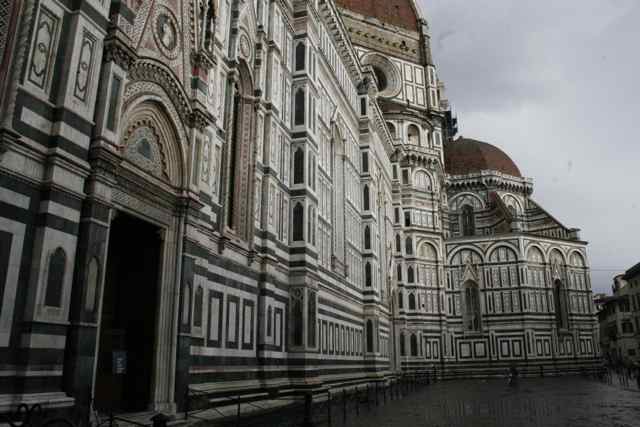
Unfortunately it was raining today (oh right, we’re still in Italy), so I was disappointed about my exterior photos. However, we did enter and found a cavernous interior with a few paintings around, some beautiful stained glass windows, but overall a simple Gothic design and as far from Baroque as you could get. It was built between 1296-1463, with its famous dome designed by Brunelleschi, and the interior dome frescos of “The Last Judgment” being painted by Vasari and Zuccari (1572-74).


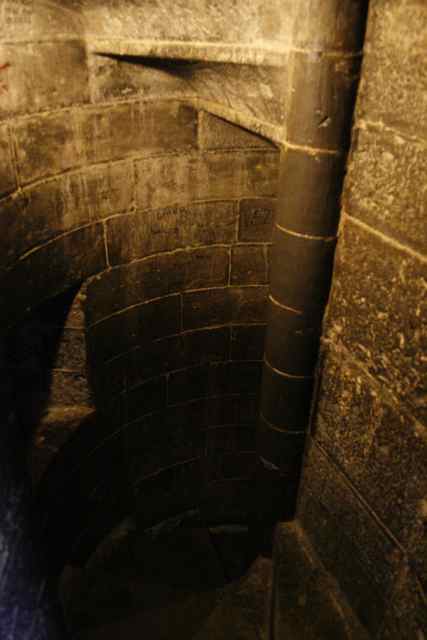
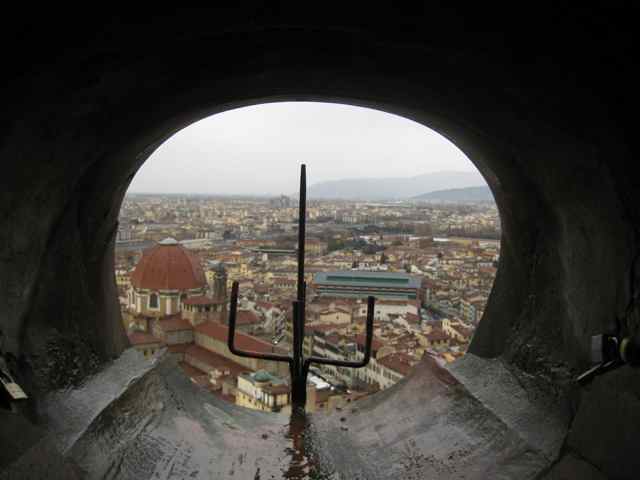
We had the option to climb up into the dome, and without any hesitation we bought our tickets and headed on up the 463 steps (well, Ron climbed 463 steps…). As we headed up the winding spiral stone staircase we would periodically get glimpses of rainy Florence outside. And obviously as we climbed higher, we got higher and higher views. All was great. No problems. Until we hit the dome and were suddenly staring into the Duomo, almost 300 feet in the air, at a stone walkway that crept around half of the dome. Now, there was a very sturdy stone banister, as well as a thick plexiglass shield reaching easily to seven feet, however, logic has no bearing on a really good panic attack.

So, as life putters on we come upon times where we have to face our fears. And that’s exactly what Ron did. He faced me; tears streaming down my face, begging him to let me go back the way we came, trying not to hyperventilate. He held my hand, while I gripped his other arm, and he slowly, ever so slowly, led me, with closed eyes and panicked breaths, around the inside of the dome. I could never ask for a better husband (we won’t even mention how a year earlier he had to perform a similar task when my dormant fear of fish staring at me manifested while snorkeling on our honeymoon in Maui and he dragged my crying, hyperventilating butt back to shore while I tried unsuccessfully to ride on his shoulders).


We made it around the top, however his Duomo task wasn’t 100% complete yet. While I waited in the stone staircase and tried to calm my breathing, he continued up to the top where he was able to stand outside and see all of Florence (he gets full credit for all those photos). Then, as we descended, me with a song in my heart, Ron suddenly stopped and said, “Uh oh, we have to do it again.” We were lower on the dome, but we had to go around half of it one more time. I managed to do it without tears this time, but I still shuffled around it holding on to Ron with my eyes squeezed tightly shut. Oh boy, how I love this man!

By the time we got down to the ground I was exhausted (never underestimate the energy required to have a full-blown panic attack). We took a break and grabbed some wonderful pizza at a local spot and watched the rain continue to drizzle.

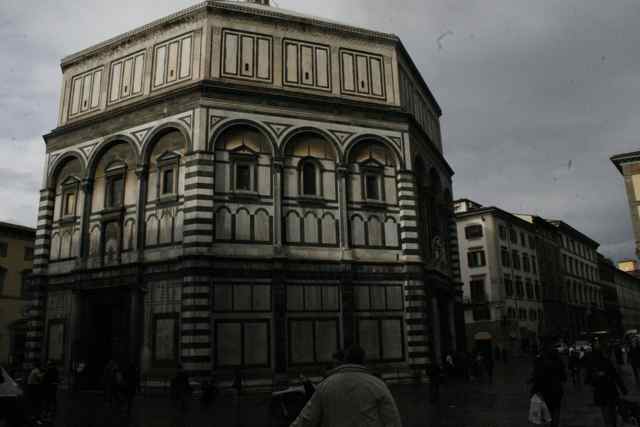
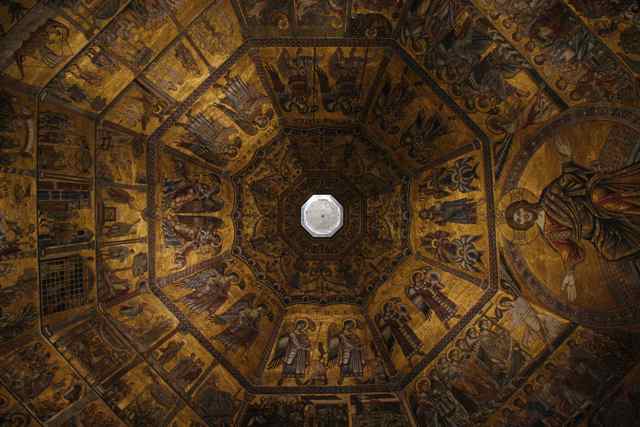
Fully fortified, we returned to the Duomo and entered the octagonal Baptistry located next to it. Next to the exterior of the Duomo, this was my favorite site in Florence! It was built between 1059 and 1128 and has three sets of very famous bronze doors created by Ghiberti, depicting scriptural stories that Michaelangelo called, “The Gates of Paradise.” Up until the end of the 19th century, all Catholic Florentines were baptized here, including Dante and members of the Medici family (very influential and powerful Florentine family from whom came three popes and the start of the Renaissance movement).


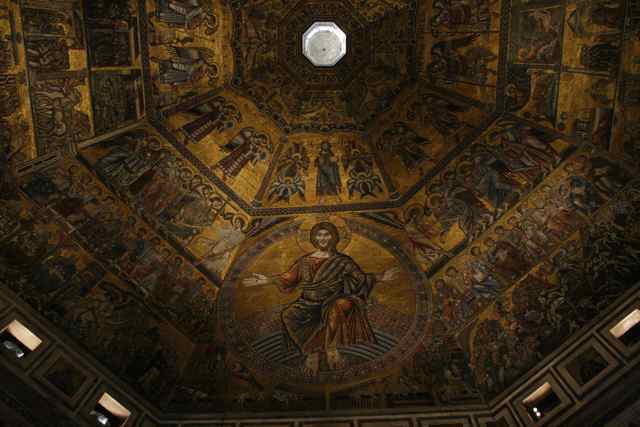
Inside, the ceiling is covered in 13th century mosaics that took my breath away (in a good way, no need for Ron’s help here). I found myself just standing in the middle of the floor, staring up for long periods of time, at the intricate glittering scenes depicting Biblical stories. There was some restoration work going on, but luckily the ceiling was fully visible and in remarkable condition.


From here, we found ourselves wandering. I had been expressing a desire to purchase Italian pottery pieces since the day we landed, but Rome proved to be unhelpful. However, to my great luck, we came upon a little shop selling pottery a few blocks away. We spent a little while there, speaking with the owner who creates works based on old designs, from the 13th, 15th century, etc. After perusing his goods, we chose four pieces. Initially three, but I expressed interest in a beautiful pitcher and he dropped the price enough to convince us to take it as well.

Next on our “How to See Florence in 48-Hours” tour was the Santa Maria Novella church. It’s a huge complex that was started in 1279 by the Dominicans, however I found it a little too Gothic and empty. Or rather, my energy levels were dropping significantly therefore any possible interest I would normally have in such sites had been dwarfed by apathy and exhaustion.

Our next church stop was the Church of San Lorenzo. It was consecrated in 393 AD, was the parish church of the Medici family and housed the last known works of Donatello.

From here I was rapidly becoming whiny and cranky, so we grabbed a bus back to the hotel and dropped off our ceramic goodies. Mildly refreshed, we walked over to Santa Croce church to attended mass. (At one point during the service a cell phone went off and I noticed one of the priests in the pews started to snicker. Finally the main priest realized it was his phone, smiled sheepishly as he turned it off, and continued the service. Interesting juxtaposition of a cell phone in a 700-year-old church.)

Santa Croce is the largest Franciscan church in the world and is believed to have been founded by St. Francis himself. The current building was built in 1294 to replace the older structure. Many famous Italians have been buried here, including Michaelangelo, Galileo and Machiavelli. There’s also a statue dedicated to Dante, although he’s buried in Ravenna. Sadly, for us, the church was under significant restoration when we saw it, so other than scaffolding and plastic tarps, little impression was made.

As we exited the church we spotted a restaurant across the way lit with strings of lights. As our attraction to these lights had not led us astray yet, we opted to try Baldovino for our last night in Florence. The lights were right! It was by far the best dinner we had had in Italy. It was a rustic, family-type restaurant, with half locals and half non-Italians. The family across the way from us brought their little dog who sat quietly under the table awaiting pizza bits. The food was fantastic, the homemade focaccia with olive oil and tomatoes was astounding, and my gnocci sent me into a happy little carb coma I was content to wallow in. Had we found this in Rome, we would have eaten here again and again. We did note that they also have Villas in Tuscany and offer various vacation packages – filed away for future planning.

On a high from our foray into the Italian kitchen, and taking advantage of the lack of rain, we strolled the streets, did some window-shopping and people-watching. We eventually found ourselves back at Baldovinos, walking back to the hotel. We were passed by a motorbike (they’re all over the place, and considering the cobbled streets and narrow alleys I can see why). Suddenly there was a crash and the bike seemed to hit an imaginary wall, throw its rear wheel into the air along with its second passenger, and the driver flew over the front wheel. Without even thinking we found ourselves running towards them, but luckily (for them, truly), others beat us to them. They were both conscious, but definitely hurt and the bike had taken some damage too. We realized that the people around us were calling for help, so we backed off and continued our walk. While our initial reaction was to help, we both realized that our lack of ability to communicate thoroughly, even utilizing Ron’s, “I don’t need a blood transfusion,” sentence, wasn’t going to be of much help.

A few blocks away we saw a young couple get out of a car and walk off down the street. As we passed their parked car, I noticed that their passenger window was down and their car was packed full of stuff. Immediately Ron’s Italian-gene kicked in (finally), and without hesitation he yelled for the man and told him, in Italian, that his window was down. The man ran back, thanked us profusely, and put up his window. Now, Ron may have thoroughly redeemed himself linguistically, however, have no fear, I will never let "No worko" die.

Italy - Day Eight (Florence Bound)

Destination Florence! We checked out of the Monte Carlo in the morning, and with the continued help of the front desk staff (who were of great assistance with any of our questions, from maps to directions to bus recommendations, etc.) we headed back to Termini Station to grab a train to Florence. As luck, or lack-thereof, would have it, it was torrentially pouring as we walked to Termini. It got so bad on our way to the bus stop that we pulled into a doorway to just get out of the deluge. We dove back into it as it let up for a moment, found our luck was not with us at the bus stop either and decided to just walk the rest of the way to the station (there is a point at which you just can’t get any more soaked).

We were able to find the correct train to Florence, got our tickets and were even able to figure out which car and seats we were in. We settled in for the ride, watching beautiful Italian scenery zip past us along the way.

Just 90 minutes later, we found ourselves standing in the Firenze Santa Maria Novella train station. So exciting! Now we just needed to figure out which bus would get us closest to our hotel. The online directions said there was a bus stop close to the hotel, but they neglected to tell us which bus we needed. This minor absent point managed to blow up into a major issue, which involved us dragging our suitcases all over the station, back and forth, up and down and up again the street in front of the station, asking this person, that bus driver, this station employee, all to no avail. Finally someone told us to take the 30 bus and after more wandering, by which point my tolerance levels were shrinking, we found the bus stop and within a few minutes the bus arrived. About time! So the next 90 minutes of our lives took us on a tour of the outlying suburbs of Florence, into fields and farms, past car dealerships, and lots and lots of apartments and houses. This was wrong, very very wrong.

Ron approached the driver at one stop and attempted to ask if the bus was going to head back to Florence, as it was seeming to head north towards Switzerland. The driver, who was on his mobile phone, couldn’t be bothered with Ron and waved him off. Feeling either extra adventurous, or merely apathetically exhausted, more likely the latter, we opted to just ride the bus and see what happens. After 90 minutes we found ourselves back at the lovely train station, where we took our one and only taxi in Italy. The ride to our hotel took about six minutes. We could have walked there and back about 24 times during our bus ride to nowhere.

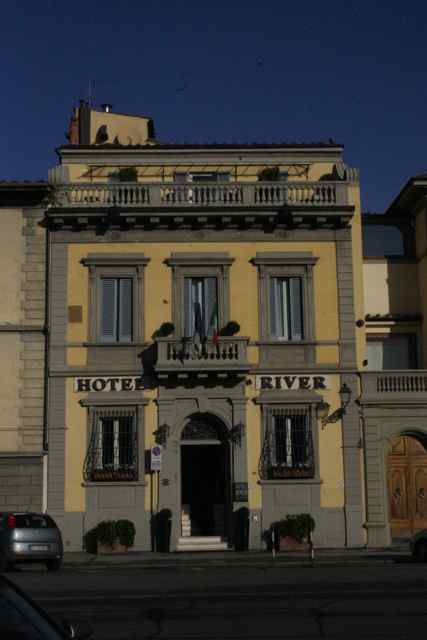
We settled in to our room, which, despite the River Hotel being on the Arno river, we had a view of the central courtyard. We then headed out to start wandering. A lot of shops were closed, but the cobbled streets were still charming. We did manage to find two shops open, one in which Ron purchased some Limoncello and I purchased a less-purely-functional winter hat with a little more pizzazz.

We did come upon the Church of Saint Ambrose, which is said to house a vial of miraculous blood. Tradition says, in 1230 AD, a priest did not properly dry the chalice following Mass and later found blood instead of the consecrated wine in it. The church was rather austere compared to the overwhelmingly ornate churches we’d left in Rome, however it did have some amazing frescos.

Our wanderings did bring us to the Duomo, which you practically smack into as you turn a corner. It’s this amazingly enormous stunning structure, seemingly wedged into the middle of Florence. I truly couldn’t get enough of it. It was like a big glorious white and green marble wedding cake. Despite the rain, yes it was raining again, it took my breath away (which was telling, considering how I reacted the following day).


We grabbed dinner at a little restaurant where we were the only customers, then walked back to the hotel for a good rest after a mildly stressful day.