Minaret Scrambles


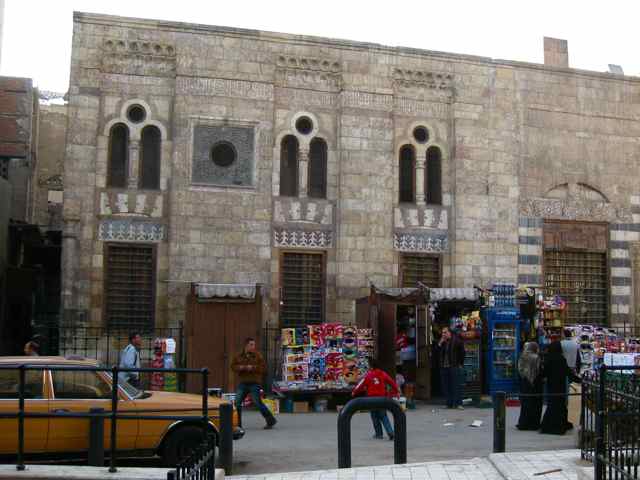
So there we were, on the opposite side of the street from the Khan, standing under the wooden roof connecting the two buildings that essentially created the Sultan Qansuh al-Ghuri Complex. Apparently there have been attempts to prevent vendors from squatting here, however you wouldn’t know it by looking. It’s the go-to spot for bras and lacy underwear (who wouldn’t want to buy those from a wooden pallet on a dusty street sold by a 14-year-old boy), scarves (I’m learning one can never have enough) and plastic hangars.

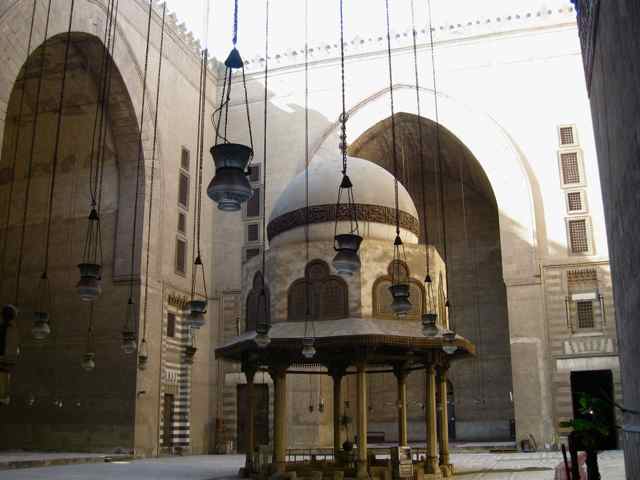
The complex of al-Ghuri was built in the early 1500s, and includes a mosque, mausoleum, sabil (public water fountain), madrasa (school for teaching the Qur’an), and a caravanserai. It was also a gathering place for Sufis. As the last complex of its size to be built before the Ottoman rule in 1517 AD, it’s apparently a classic example of late Mamluk architecture.

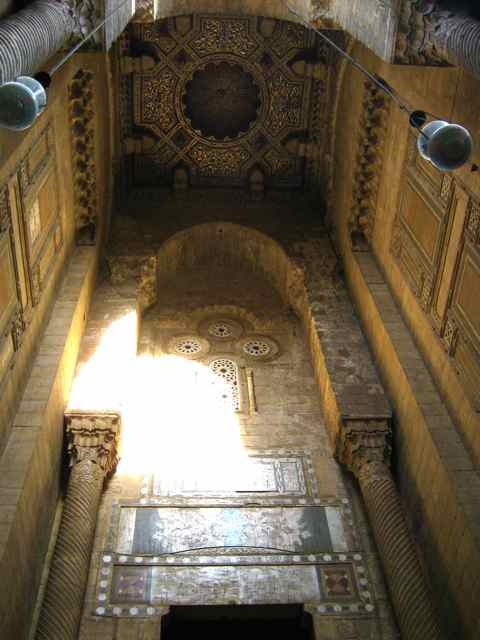
The one side held the sabil, madrasa and caravanserai, but Haitham and I climbed the other stairs to the mosque. The inside was quite beautiful, with an open central courtyard and towering open-air roof. The walls were lined with marble and limestone and the floor was covered in multi-colored marble. And there were a handful of kittens playing back near the women’s area (which is behind a screen, out of sight).

As we were looking around, taking photos and admiring the architectural details, Haitham was approached by a man who offered to take us up the minaret. Why not?! So we gathered up our shoes from the entrance, carried them through the mosque to a door on the other side and were led up a small stone staircase. We reached the top of the mosque and could see right across the tops of Cairo’s buildings. We could also see over the edge to the fabric/bedding/clothing/spice markets below. (Note the visual hiccup of minarets and satellite dishes.)


At the edge of the roof was the entrance to the square, red and white checked minaret. I’ve been told, on another tour, that this was the only square minaret in Cairo, however I have not yet been able to confirm that anywhere else, so it might just have been one of those “Cairo facts” that are thrown about. But apparently I can tell you that the five spires currently on the top are a misrepresentation of the original, which only had four. (And they thought no one would notice.)

So our guide preceded us up the interior stone steps of the minaret. I have to assume he’s done this once or twice before. Which leads me to wonder aloud why he doesn’t come prepared with a flashlight for his unsuspecting followers; because inside it is as dark as a moonless night in the backwoods of Maine. I mean, dark! Stumble along, drag your hand on the wall in front of you and use your toes as step-finders and just keep muttering, “I’ll be fine,” type of dark.

We were fine, and the view was worth the temporary blindness. Luckily we also had a clear day. So here you see, what is sometimes called, medieval Cairo spread beneath you. I know, looks a lot like the other parts of Cairo. But this dirt is medieval dirt.


Despite Haitham’s expression, we were both really quite proud of ourselves, having both admitted to bouts of vertigo at times in our pasts.

So, having taken our fill of photos, we inched our way back down. I declined the oh-so-kind offer of our guide to hold my hand, and instead just kept blinking and shuffling until my eyesight returned and I was at the bottom again. Haitham dutifully tipped him, however despite the rather significant sum, he was obviously hoping for more. Welcome to Cairo!

So we finally zipped over to the Khan for one quick errand, then prolonging the adventure we decided to walk home from here – which I have never done. Along the way we passed a guy selling grilled corn on a make-shift stand and Haitham bought one. My street food introductions continue and I had a bite and it was delicious! It’s just raw corn, grilled (or burnt) over hot coals while being fanned with a filthy mass of feathers (we’ll have to come up with something catchier for the marketing campaign). The guy’s fingers were charred black from turning the cobs – I’m sure there’s a metal tong store just around the corner somewhere.

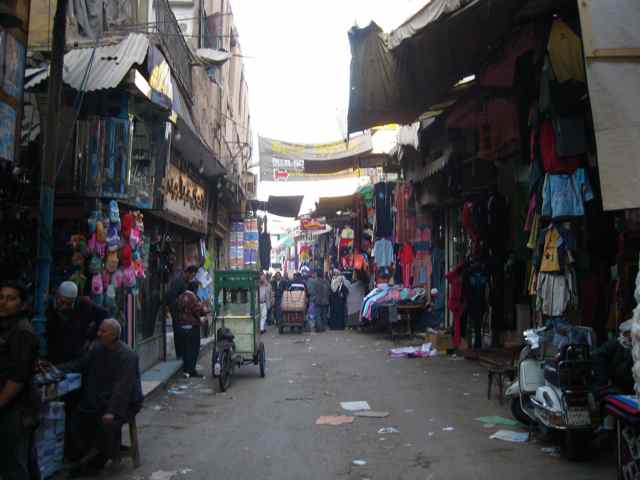
We ambled on, through a fabric market, past the bolts of upholstery and satin and linen and lace. Past stores selling everything imaginable, and some things actually unimaginable.


We passed a huge open market that I’d only seen from cabs as I drove by on the fly-over. There were throngs of people everywhere, all along the walk until we got finally to the downtown area and stumbled home to Zamalek. By this point we were admittedly exhausted, dirty, tired and extremely thirsty. But oh boy was it worth it!

The one thing I forgot to mention that I also brought with us was a pedometer, which dutifully tracked our 16,000 steps, equaling more than ten miles of walking. I think Haitham might be trying to kill me.
The Streets of Cairo, Non-intrepids need not apply

So I have to confess something here. These two collective days wandering with Haitham have been two of the best days I’ve had exploring Cairo. I’ve just felt very free to go anywhere, as long as Haitham’s there. It’s not a safety concern, but traveling with a male fluent Arabic-speaker quashes all my getting-lost-anxiety. Plus, Haitham is an intrepid explorer and willing to go anywhere, which was great fun!
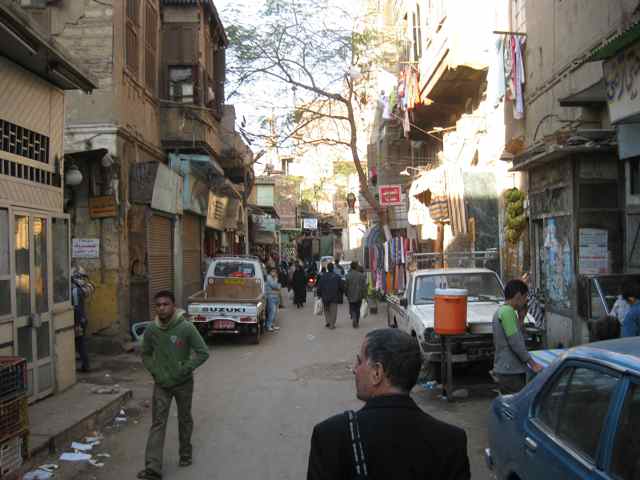
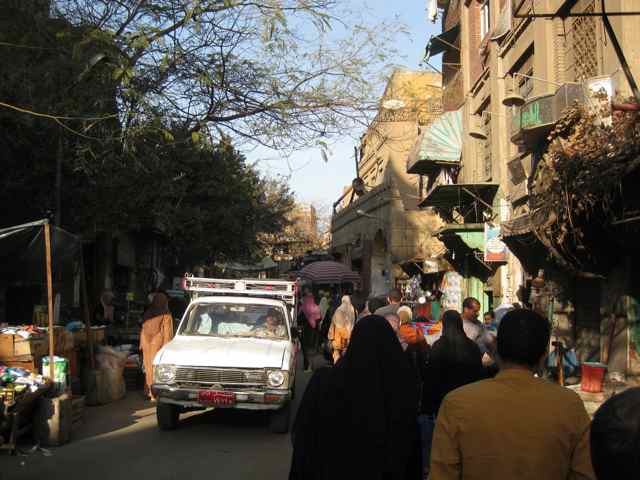
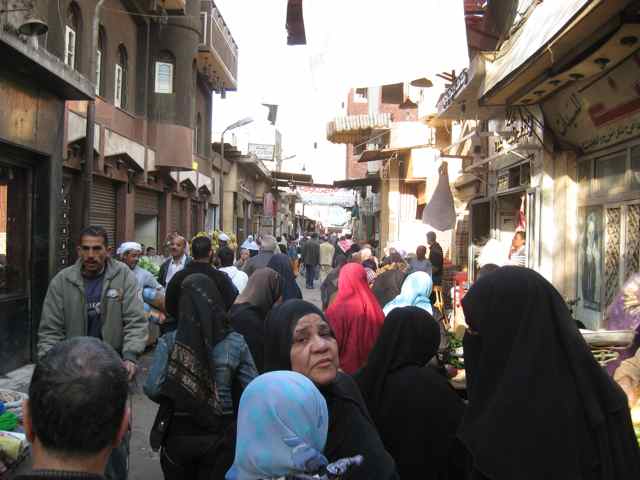
So after we finished at the two mosques, we decided to walk to Khan el Khalili, which involved us walking around the mosques, down the main street, asking a few people directions along the way, and finding ourselves facing a crowded narrow street full of sounds, smells and sights galore that would allegedly lead us to our destination!


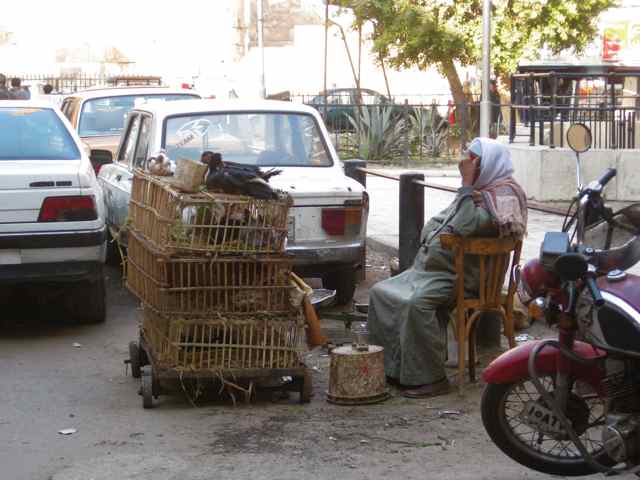
As you can see in the pictures, the street led us through markets and shops, past vegetable stands, bread sellers (we bought some more for tonight’s dinner), fruit sellers, loofah sellers (Haitham bought a huge one for 1EGP (~$0.17) and said they were the best around – I neglected to follow his lead, so now I’m on the lookout for the loofah man), past unitentifiable meat sellers, past someone selling just feet (yes, just hooves), and sadly past a lot of live animals for sale, including bunnies, ducks, pigeons and chickens. We also passed shoe shops and the renouned “Tentmaker’s Street,” which is a fantastic old caravanserei of small stalls full of beautiful appliqué blankets, pillows and if you want them, tents (I hear people have them made for weddings and such).


This led us to Bab Zuwayla, which is a medieval stone gate dating from around the 11th century that’s connected to the Mosque of Sultan al-Muayyad (circa 1420). There are other mosques along the way (this was at least the sixth one, according to the map, just on this narrow strip), however we decided to leave them for another day and keep walking.


From here we entered the fabric, bedding and clothing area, so were luckily free from more live bunnies. Being a vegetarian in Cairo is really very easy for me, especially since I love hummous, baba ghanoush, fattoush, falafel, etc., however "bunny" moments like these make it … less easy.

As promised, our path led us right to the Khan, however before venturing in, we found ourselves being drawn into the Mosque of Al-Ghuri, and before we knew it, we were climbing to the heavens.

Haitham’s Cairo

For my next outing with Haitham I came fully prepared: water, sturdy socks, comfortable shoes, and a camera with two fully charged batteries. Now that I knew what would be in store, I was not going to miss a thing!

We started at the two big mosques that stand at the base of the Citadel: Sultan Hasan Mosque (on the left) and the Mosque of al-Rifa'i (on the right). Again, we managed to find a taxi driver who didn’t know how to get there. So between directing his driving, Haitham also enlightened this young fellow on the history of his birth city (once a professor, always a professor; believe me, I’m the daughter of one and I know; it can't be turned off).

The Mosque of Sultan Hasan was built for Sultan al-Nasir Hasan, who ruled Egypt for twelve years, starting from the age of thirteen. Construction was started in 1356, however he was assassinated in 1361 and the mosque wasn’t finished until 1363.

Over 600 years later, the mosque is revered as an eminent example of Mamluk architecture, as well as being known for its enormous size. The entrance itself is over 131 feet tall, and at the time of construction the minaret was the tallest in Cairo at over 267 feet (although, sadly it actually collapsed killing 300 people). The mosque itself covers a whopping 86,000 square feet of space. Truly monumental.

Entering the mosque you really can’t fight the feeling of what Alice must have felt when she ate the “shrink” side of the mushroom. The scale is so large, it’s a bit disorienting. Not to mention the sudden silence with the void of Cairo-noise. The central courtyard has a large fountain that was not originally intended for ablutions, although that’s what it’s used for today. And in each corner are heavy wooden doors, leading to one of the four madrasas, or colleges, for teaching the four rites of Sunni Islam. (I was going to try to explain the four schools, but honestly I’m still uncertain, so I won’t share the confusion at this point.) At one time, they could accommodate 506 students and 340 staff with over five stories encompassing 174 rooms. When we were there, it was us, about six “staff” (assuming those sitting around were staff), and a mere handful of other curious tourists, so we couldn’t really get the true feel of standing in a mass of 850 people.

The interior walls are brick covered with stucco or bands of colored marble. The floors are also covered in marble inlay. The mihrab and minbar are particularly striking with their marble stripes and gold accents. It’s said that Hasan was able to build such a grand structure because there was a significant surplus in the royal treasury from the estates of victims of the plague of 1348.


Behind the qibla wall is the mausoleum. Following his assassination, Hasan’s body was apparently never found, but his sons have since been buried here. The interior, when we visited, was immense and dark, so I have no photos and can’t really comment on any wow-factors. The guide book describes it as “lofty and somber.” Well said.

Standing next to the Mosque and Madrasa of Sultan Hasan, completing the matching set of gargantuan bookends, is the Mosque of Al-Rifa’i. It was commissioned by Khushyar Hanim, the mother of Khedive Isma'il Pasha (who ruled 1863-1879), on the site of the then-current shrine for Islamic Sufi saint Ahmad al-Rifa'i. Due to financial and logistical issues, it was built in two phases over a period covering 1869 to 1912.

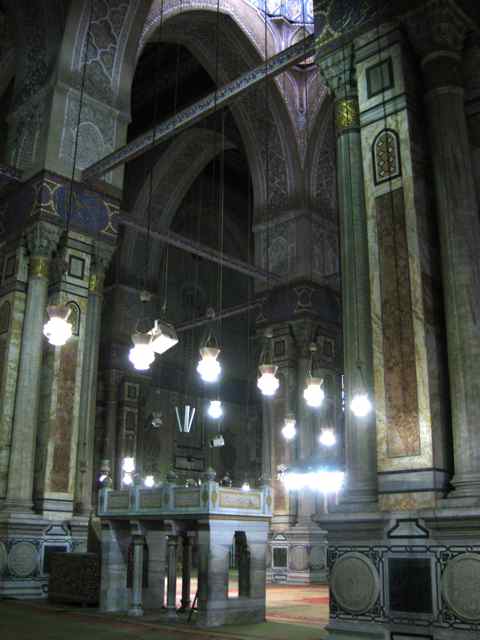
The original architect designed it to match the size and appearance of its bookend mate, Sultan Hasan. However, the interior is very different, with no inner courtyard and tombs lining the sides. It’s also extremely ornate, utilizing nineteen types of marble from seven countries and gold imported from Turkey for the gilded ceiling.


The new shrine for relics from Ahmad al-Rifa’i is immediately in front of you as you enter, decorated as he would have surely wanted, with plastic wreaths and colored pea-lights. It is still a well-visited site for people seeking his blessing in their life. Without the open central courtyard, the space seems even more immense than Sultan Hasan, as we lurk around the edges. We come to one section housing the tombs of King Farouk (essentially the last king of Egypt, ousted in the 1952 revolution), his predecessor King Fuad, Fuad’s mother and Mohammad Reza Shah Pahlavi, the Shah of Iran, who died in exile in Egypt and was once married to King Farouk’s sister (handy Trivial Pursuit factoid).

As we wander through the central sanctuary, we are approached by a young man who speaks with Haitham. He offers to show us another area of tombs. Feeling adventurous we follow him through a doorway leading outside. Immediately to the left is another huge door, which he opens using, what he claims is the original 100-year-old skeleton key. Inside is a line of three funerary chambers containing massive ornate marble tombs for Khushyar Hanim, her son Isma'il Pasha, his three wives (they have to share the same room even in death), and a few others. We somehow acquired a third tourist along the way, so the three of us admire the artistry, which really is impressive with just a dash or two of gaudy, listen to our guide’s history lessons, and then pay him the requisite bakshish. It was worth it.

From here we ventured back out into the daylight with the plan of doing a “little” walking. And having been on Haitham’s walks before, I knew what was in store and I couldn’t wait!

Picture Pages - Laundry

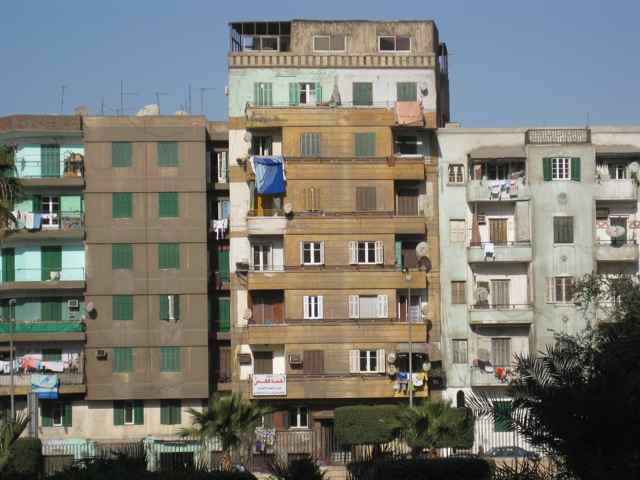
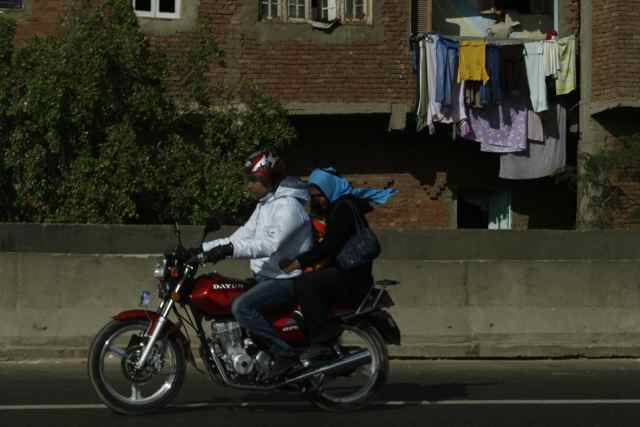
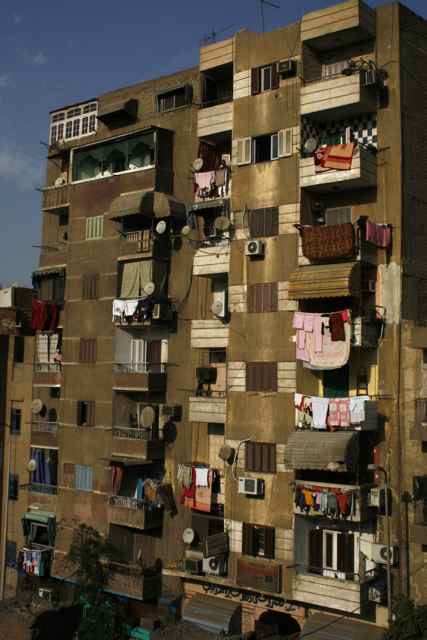
Cairo is not known for its beautiful architecture (other than the pyramids, of course). There are some really beautiful buildings around, however most people point them out saying something like, “It looks Italian,” or “It looks like Europe.” Basically, most of the structures are big, blocky and bland. However, where their color, texture and life comes in is through the fabric… in particular, the drying laundry, and I love it. (And yes, it still mystifies me that you’d go to the trouble of washing something, then hang it out in the dusty dirty air… but maybe you beat it clean after it’s dry.)

So here are some silly laundry shots:


Picture Pages - Bicycles


In a momentary lull in my “Tales with Haitham” exploits (i.e., lazy writer syndrome), I wanted to share some of the “street scenes” we’ve captured. Some are from my foot-wanderings, but the majority are gathered during our weekly jaunt to the commissary, which we approach like any true road trip, with water, maybe some snacks, and of course, a camera.

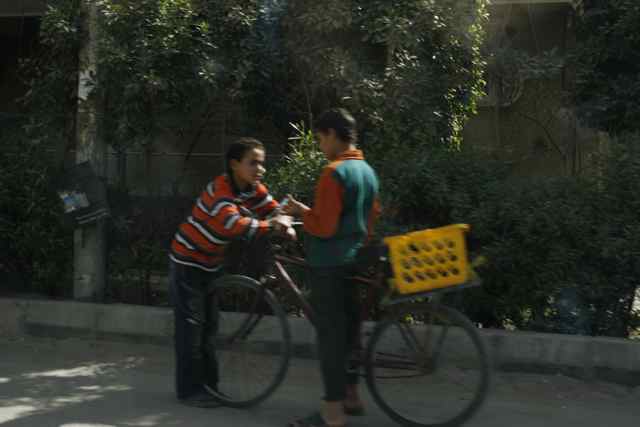
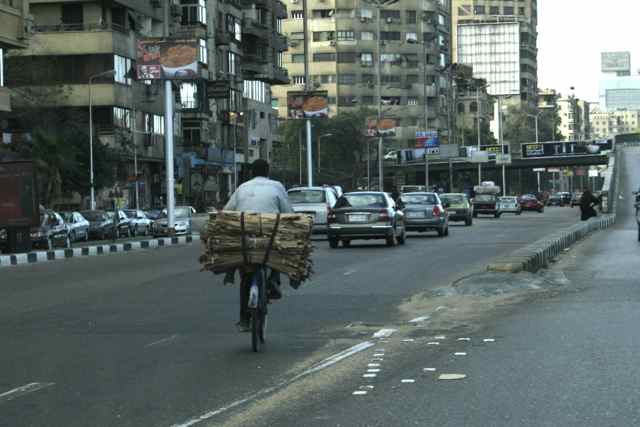
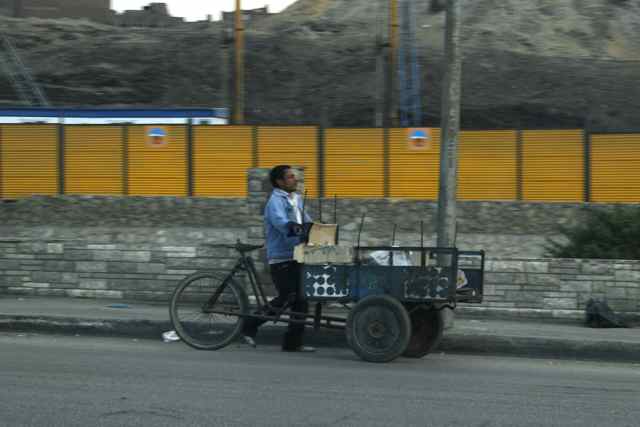
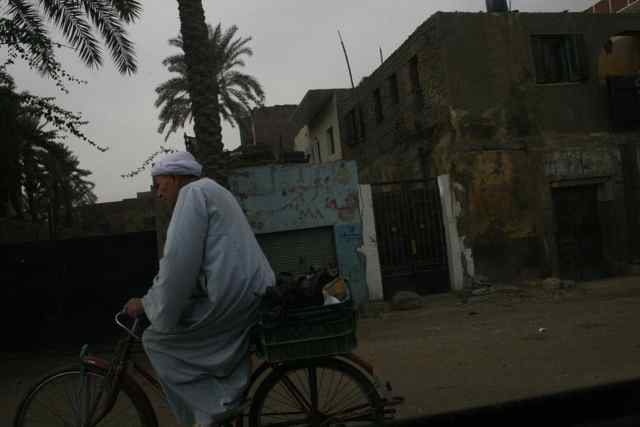
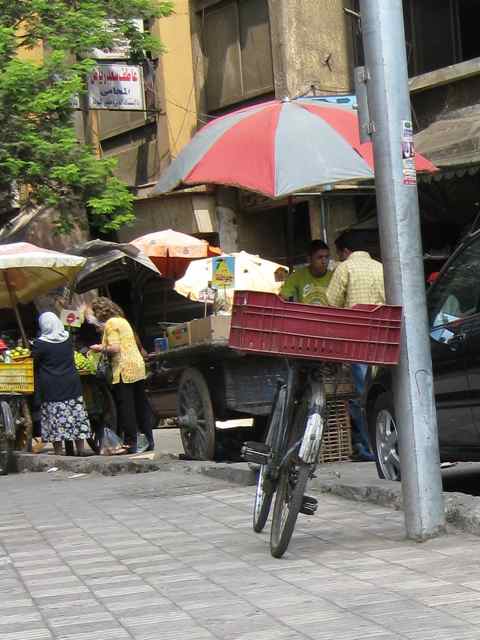
I’ve expanded my interest in “bread bicycles” (which remain my favorite), to include other bicycles. Essentially they’re all over the place, in all conditions (though usually the term “well-used” or “antique” applies to most). So here follows an assortment of the typical Cairo bicycle and all its uses: